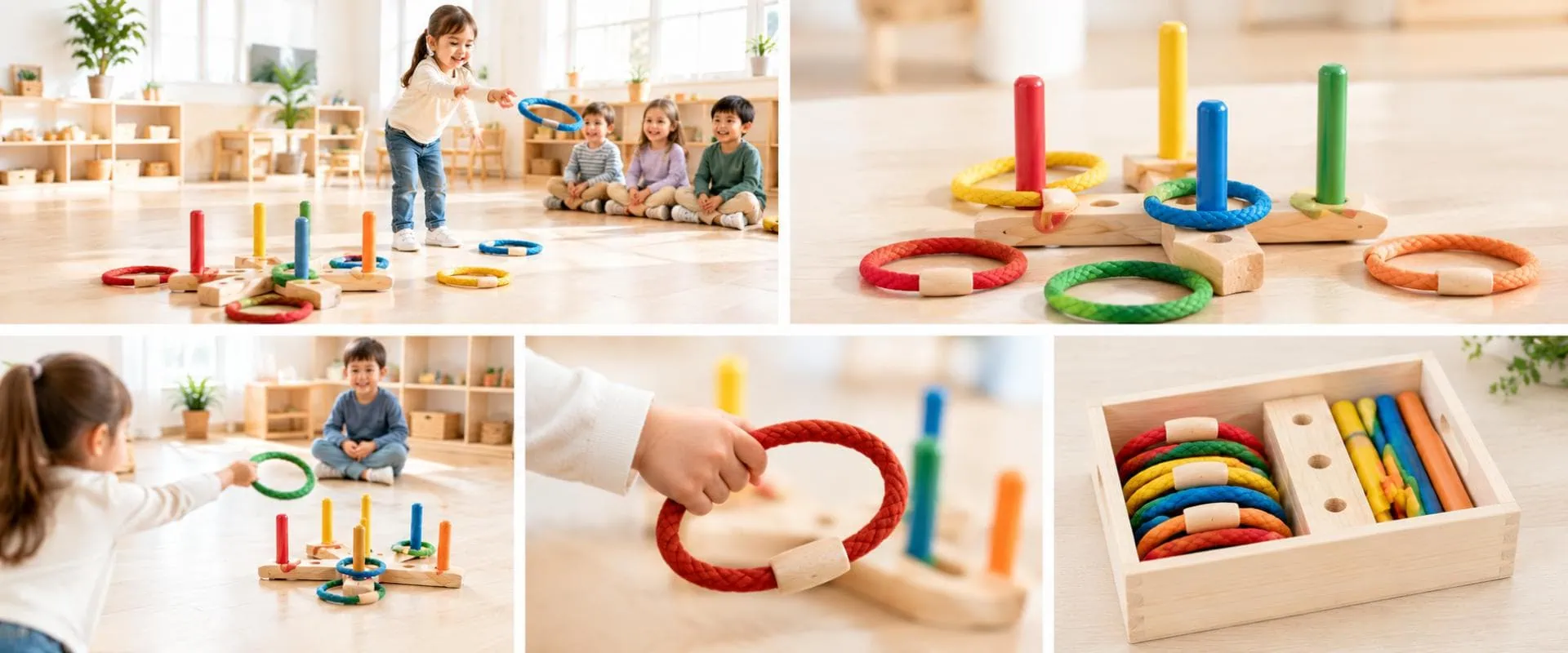
Interactive preschool toys are more than classroom entertainment. When children sort, stack, connect, build, move, compare, and role-play, they actively develop fine motor control, spatial awareness, communication, problem-solving, and confidence. For distributors, importers, and educational suppliers, choosing the right products means balancing learning value with safety, durability, and long-term commercial potential.
Since 2008, Sing2sky has focused on wooden educational toys and preschool learning equipment for international distributors and education projects. This guide explains seven practical types of interactive preschool toys and the features buyers should evaluate before adding them to a product range.
Why Wooden Interactive Preschool Toys?
Well-designed wooden toys invite children to participate rather than simply watch. A child must decide where a block belongs, how pieces connect, what a structure represents, or how to solve a physical challenge. This active involvement makes the learning process visible and gives teachers more opportunities to observe how children think, communicate, and respond to problems.
Wooden classroom materials can also offer strong long-term value when they are designed for repeated institutional use. Rounded edges, smooth surfaces, stable structures, appropriate component sizes, and durable finishes are especially important in preschool environments where products may be used by many children every day.
What Makes a Toy Genuinely Interactive?
- Physical participation: Children grasp, rotate, connect, balance, carry, push, pull, or arrange components.
- Decision-making: The toy offers choices instead of producing only one predetermined response.
- Problem-solving: Children test ideas, notice results, make adjustments, and try again.
- Communication: The activity can encourage children to describe, negotiate, cooperate, and share ideas.
- Multiple outcomes: Children can use the same materials in different ways as their abilities develop.

Interactive Play Beyond the Screen
Interactive does not have to mean electronic. Screens and sound-based products can provide certain kinds of feedback, but hands-on materials create a different form of engagement. Children receive information through movement, touch, balance, sound, resistance, shape, and the reactions of other children.
- Physical interaction supports grip strength, hand-eye coordination, bilateral movement, and body control.
- Cognitive interaction encourages classification, sequencing, spatial reasoning, planning, and cause-and-effect thinking.
- Social interaction creates opportunities for turn-taking, cooperation, negotiation, and shared problem-solving.
- Creative interaction allows children to transform simple materials into buildings, stories, vehicles, environments, and new challenges.
This is why a relatively simple wooden construction set can remain engaging for a long time: the material does not provide the entire experience. The child contributes the idea, the method, and the outcome.
Seven Essential Types of Interactive Preschool Toys
A balanced preschool range should support several areas of development and offer activities for both individual and group use. The following seven categories give distributors and educational buyers a practical foundation for building an interactive learning collection.
Stacking, Sorting, and Matching Toys
Stacking rings, shape sorters, nesting pieces, color-matching materials, and classification sets introduce children to size, shape, color, sequence, and comparison. These products are particularly useful for toddlers and younger preschool children because the action and result are easy to understand.
- Learning focus: Visual discrimination, early mathematics, hand-eye coordination, and problem-solving.
- Buyer considerations: Age-appropriate piece size, stable bases, smooth finishing, clear visual differences, and easy classroom storage.
Puzzles and Fine Motor Toys
Wooden puzzles, threading activities, lacing boards, peg toys, locks, gears, and manipulation panels require precise hand movements. Difficulty can progress from large inset pieces for younger children to multi-step challenges for older preschool groups.
- Learning focus: Pincer grip, visual-spatial reasoning, concentration, sequencing, and self-correction.
- Buyer considerations: Progressive difficulty, secure components, durable graphics, replacement-part planning, and suitability for repeated use.
Blocks and Construction Sets
Unit blocks, tabletop building blocks, roadway systems, architectural pieces, and large construction materials allow children to plan and build without requiring a single correct result. The same collection can support towers, bridges, houses, roads, enclosures, and imaginative small-world play.
- Learning focus: Spatial reasoning, balance, early engineering, mathematical thinking, cooperation, and creative planning.
- Buyer considerations: Consistent dimensions, compatibility between sets, component variety, storage systems, and availability of expansion packs.

Mechanical Construction and STEM Toys
Bolt-and-nut construction sets, gears, connectors, wheels, and mechanical building components introduce children to assembly, motion, structure, and basic engineering. Unlike fully open-ended blocks, these products provide a more structured STEM challenge because children must understand how specific parts connect and function together.
- Learning focus: Mechanical reasoning, tool use, planning, persistence, and fine motor control.
- Buyer considerations: Connector strength, comfortable component size, clear activity guidance, spare parts, and scalable set configurations.
Dramatic and Role Play Toys
Play kitchens, market stands, workbenches, doll furniture, community-role sets, and other pretend-play materials help children recreate familiar experiences and explore new social situations. These products become more interactive when several children can use them together.
- Learning focus: Language, storytelling, empathy, cooperation, social understanding, and emotional expression.
- Buyer considerations: Classroom-scale dimensions, stable structures, accessible storage, rounded corners, and flexible themes that suit different markets.
Sensory and Loose Parts Play
Textured pieces, wooden discs, natural-form blocks, translucent elements, sound materials, mirrors, and other loose parts invite children to compare, arrange, combine, and investigate. Because these resources do not prescribe one outcome, they can support different interests and ability levels.
- Learning focus: Sensory exploration, observation, creativity, classification, descriptive language, and sustained attention.
- Buyer considerations: Material variety, hygiene and cleaning requirements, storage trays, age grading, and clear component inventories.
Sand, Water, and Outdoor Discovery Toys
Sand and water tables, channels, funnels, measuring tools, outdoor blocks, ramps, and movable play equipment allow children to investigate flow, volume, weight, movement, and cause and effect. These activities can combine scientific observation with collaborative physical play.
- Learning focus: Early science, measurement, gross motor coordination, teamwork, experimentation, and environmental awareness.
- Buyer considerations: Drainage, weather resistance, material suitability, stability, maintenance instructions, and local outdoor-use requirements.
What Distributors and Educational Buyers Should Look For
An attractive product photograph is not enough to evaluate interactive preschool toys. Buyers should review how a product performs throughout its full commercial and classroom life cycle.
- Age appropriateness: Check component size, activity difficulty, dimensions, and recommended age group.
- Safety requirements: Confirm the applicable testing and documentation for the product type and destination market, such as EN71 or ASTM F963 where required.
- Institutional durability: Evaluate joints, connectors, surface finishing, hardware, packaging, and resistance to repeated use.
- Educational purpose: Make sure the activity supports identifiable skills rather than relying only on novelty or decoration.
- Range compatibility: Products that work together can increase repeat orders and make it easier to build complete classroom solutions.
- Packaging and support: Consider assembly instructions, component lists, activity guidance, spare parts, private-label options, and sales materials.
- Supply consistency: Review production capacity, quality-control procedures, lead times, and the manufacturer’s ability to support future replenishment.
For a distributor, the strongest range is not necessarily the one with the largest number of isolated products. A coordinated system of compatible materials, clear age levels, and complementary learning functions is easier to present to schools, early-learning groups, and project customers.
Frequently Asked Questions
Are wooden toys better than electronic toys for preschool learning?
They support different kinds of interaction. Wooden toys are especially effective when the goal is hands-on manipulation, construction, spatial reasoning, fine motor practice, collaboration, and imaginative play. The best choice depends on the learning objective, age group, classroom environment, and quality of the product design.
How should distributors select an initial preschool toy range?
Start with a focused mix that covers several learning needs: fine motor play, construction, role play, sensory exploration, and active or outdoor discovery. Choose compatible products with clear age positioning, then expand according to customer feedback and repeat-order data.
Can interactive preschool toys be customized for local markets?
Many products can be adapted through private labeling, packaging, color selection, component configuration, manuals, or product combinations. The available options and minimum order requirements depend on the level of customization, so distributors should confirm specifications before sampling and production.
What information should buyers request before placing a bulk order?
Request product dimensions, materials, component quantities, age recommendations, packaging details, testing information, assembly requirements, production lead time, trade terms, and replacement-part policies. A pre-production sample or confirmed sample is also valuable when developing a new range.
Build a Stronger Preschool Learning Range
The best interactive preschool toys give children an active role in the learning process. They invite children to move, build, compare, imagine, communicate, and solve problems while giving educational buyers durable resources that can support repeated classroom use.
Sing2sky works with distributors, importers, educational suppliers, preschool groups, and project partners seeking wooden educational toys and complete learning-space solutions. Explore our product catalogue, or contact our team to discuss product selection, OEM or ODM requirements, samples, and bulk-order planning.