

Educational construction toys give children opportunities to build, connect, balance, compare, test, and redesign. For early learning environments, however, selecting a construction system requires more than choosing an attractive block set or the highest piece count.
Distributors, importers, education groups, and project suppliers need to evaluate age suitability, educational purpose, component compatibility, safety documentation, classroom space, storage, maintenance, and replacement support.
This guide explains the main types of educational construction toys and presents nine practical selection tips for building a useful, manageable, and age-appropriate collection.

What Are Educational Construction Toys?
Educational construction toys are materials that children arrange or connect to create structures, models, routes, patterns, or functional assemblies. They include traditional blocks, hollow blocks, interlocking pieces, railway systems, architectural components, and bolt-and-nut construction sets.
These systems do not all offer the same experience. Loose blocks rely primarily on balance and gravity. Interlocking pieces introduce connection strength and orientation. Mechanical sets add assembly sequences, fasteners, and moving components.
The best choice depends on what children are expected to explore—not simply whether the product is labeled “STEM,” “Montessori,” or “open-ended.”
How Construction Play Supports Early Learning
Construction play creates opportunities for children to compare dimensions, plan structures, test ideas, explain decisions, and collaborate. The NAEYC discussion of learning through block play highlights the breadth of experiences that building materials can offer.
Depending on the material and activity, children may practice:
- Spatial reasoning: rotating pieces, comparing positions, and arranging structures
- Early mathematics: counting, measuring, sorting, repeating patterns, and comparing proportions
- Problem-solving: identifying why a structure falls or a connection does not fit
- Motor coordination: carrying, placing, connecting, turning, and aligning components
- Communication: explaining plans, describing structures, and negotiating shared ideas
- Persistence: adjusting a design after an unsuccessful attempt
These are learning opportunities rather than guaranteed outcomes. The product, available time, classroom arrangement, adult support, and children’s interests all influence the experience.

Comparing the Main Construction Systems
Unit Blocks and Loose Building Pieces
Unit blocks use proportional dimensions that allow pieces to relate predictably to one another. Children can explore rows, towers, bridges, enclosures, patterns, and representations without needing a connection mechanism.
Buyers should examine dimensional consistency, flatness, surface quality, shape balance, and the number of frequently used foundational pieces. A set with many unusual shapes but too few basic rectangles may limit everyday building.
Large Hollow Blocks
Large hollow blocks support larger-scale construction and may invite children to move around a shared building area. Hollow construction can reduce weight compared with a solid piece of equivalent size, but weight and handling still need to be checked.
Do not assume that a hollow block structure is suitable for sitting, standing, climbing, or entering. Those activities require explicit manufacturer approval, appropriate design, and applicable safety assessment.
Interlocking Construction Systems
Interlocking construction pieces introduce connection mechanisms that differ from loose stacking. Children must consider orientation, alignment, connection force, and how components can be separated.
Before purchasing, test whether the connection is manageable for the intended age group. A system that is too stiff may require constant adult assistance, while loose connections may prevent the intended structures from holding together.
Mechanical and Bolt-and-Nut Sets
Mechanical construction sets introduce fasteners, assembly sequences, wheels, axles, and other functional components. They can offer a more structured engineering experience than traditional loose blocks while still allowing different builds.
Buyers should assess fastener size, turning resistance, component strength, pinch points, exposed projections, and the level of supervision required.
Railways, Roads, and Architectural Sets
Track, road, town, and architectural systems combine construction with storytelling. They can encourage route planning, spatial organization, community themes, and shared imaginative play.
Check compatibility between pieces and expansion sets. Accessories, vehicles, connectors, and figures may have different age restrictions from the larger construction components.

9 Essential Tips for Choosing Educational Construction Toys
1. Define the Intended Learning Experience
Start by identifying the purpose of the collection. Is the priority open-ended building, early engineering, collaborative large-scale construction, fine-motor assembly, mathematical relationships, or imaginative town play?
A clear objective makes it easier to compare educational construction toys and avoid buying several systems that duplicate the same experience.
2. Confirm Age Grading and Foreseeable Use
Review the manufacturer’s age recommendation, warnings, component sizes, handling demands, and intended use. Consider whether younger children could access the materials in a mixed-age environment.
Age suitability cannot be determined by appearance alone. A large structure may contain small connectors, detachable wheels, or other components unsuitable for younger users.
3. Evaluate the Connection Method
Loose stacking, friction fitting, interlocking, magnetic connection, and threaded assembly create different physical demands. Test how easily children can connect and separate pieces, whether joints stay consistent, and whether repeated use affects performance.
Magnetic systems require particular attention to magnet retention and applicable safety requirements. A magnet being hidden inside a component does not remove the need for assessment.
4. Review Materials and Construction Quality
Assess the complete product rather than assuming that one material is always best.
| Material | Potential strengths | What to check |
|---|---|---|
| Wood | Distinct weight and texture; suitable for stable forms and proportional blocks | Splinters, cracks, finish compatibility, joints, moisture sensitivity, and piece weight |
| Plastic | Can support lightweight forms and precise connectors | Connection quality, impact resistance, materials, cleaning instructions, and outdoor suitability |
| Foam | Can provide lightweight, cushioned construction pieces | Tearing, detachable fragments, coatings, compression, hygiene, and age grading |
| Mixed materials | Can combine structural, visual, and mechanical features | Every component, adhesive, fastener, coating, and connection interface |
No material is automatically safe, sustainable, weatherproof, or maintenance-free. Claims should be supported by the actual design, specifications, documentation, and intended use.
5. Check Shape Balance and Compatibility
Piece count alone is a poor measure of value. Examine how many foundational pieces, connectors, bases, wheels, tracks, or specialist shapes are included and whether they work together effectively.
For a multi-site education group or distributor, compatibility between batches and expansion sets can be important. Ask whether dimensions and connectors remain consistent across the product range.
6. Plan Quantity Around Actual Use
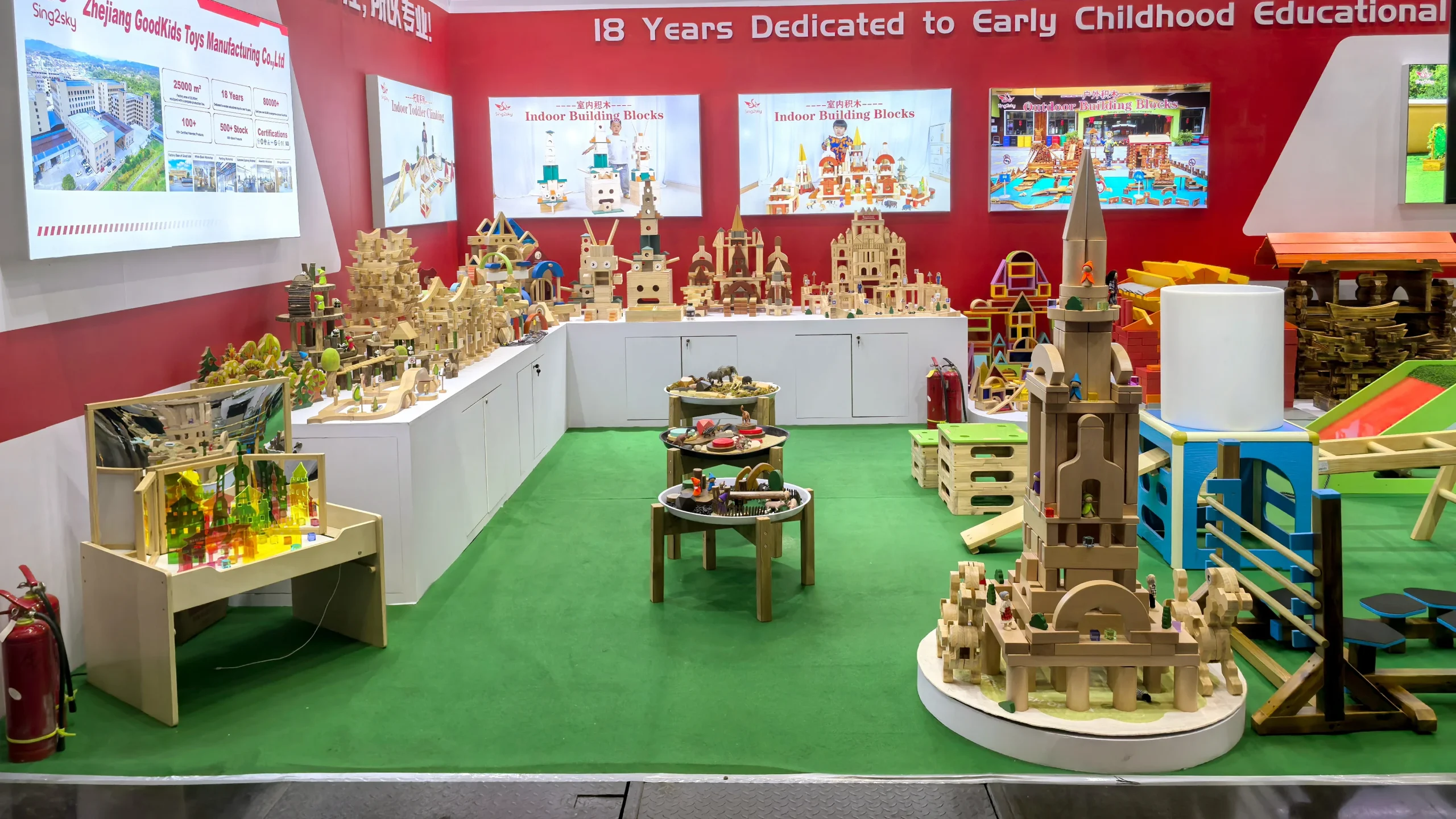
There is no universal minimum of 200, 300, or 400 pieces for a particular age group. Plan quantities around enrollment, simultaneous users, activity type, room size, storage, and the size of each component.
Where possible, trial educational construction toys with a small group before standardizing a large purchase. Record which pieces are frequently used, which are missing during activities, and which add little practical value.
7. Verify Product-Specific Safety Documentation
Ask which requirements apply to the destination market and whether available reports match the actual product, materials, age grading, and configuration.
The CPSC toy-safety guidance explains that ASTM F963 includes both generally applicable and product-specific requirements. US requirements should not be described as covering all of North America.
For younger children, review applicable small-parts and choking-hazard requirements, including components that may detach during testing. Supervision is not a substitute for compliance.
CE marking, toy-safety testing, forest-sourcing certification, and voluntary emissions certification serve different purposes. They should not be treated as interchangeable evidence of complete product safety.
8. Include Storage and Maintenance in the Budget
Construction collections often need shelving, component trays, labeled containers, or mobile storage. Confirm storage dimensions, total loaded weight, and how staff will move the collection between rooms.
Ask for cleaning instructions and replacement options before ordering. A missing specialist connector can affect an entire system, while a missing loose block may have less impact.
9. Assess the Supplier’s B2B Support
A reliable supplier should help buyers confirm specifications, sample approval, packaging, labeling, testing scope, quality inspections, production lead times, and shipment information.
Distributors sourcing educational construction toys should also ask about private-label options, product photography, demonstration videos, instructions, carton data, and replacement-component availability.
Age-Appropriate Selection Without Rigid Milestones
Children’s construction play does not follow an identical timetable. Some explore by carrying and arranging, others stack, connect, build enclosures, or develop detailed representations. These activities may overlap and reappear in different contexts.
- Younger learners: prioritize products explicitly intended for their age, manageable weight, straightforward actions, and appropriate component sizes.
- Developing builders: offer opportunities to compare, stack, enclose, connect, and collaborate without introducing unnecessary complexity.
- More experienced builders: add compatible shapes, mechanical elements, planning prompts, or design challenges when interest and readiness are observed.
Use manufacturer age grading alongside observation. Do not assume that every five-year-old is ready for smaller components or that every toddler can safely handle a large wooden piece.
Indoor and Outdoor Construction Play
Indoor construction areas need a stable surface, clear circulation routes, accessible storage, and enough space for the intended group. There is no single floor-area requirement suitable for every system.
Outdoor use requires additional checks. Confirm whether the product is designed for the environment, how moisture and sunlight affect it, and whether it needs covered storage after play.

Do not substitute construction-site materials, concrete blocks, or unassessed scrap wood for purpose-designed children’s equipment. Ordinary building pieces should not be used as climbing or load-bearing equipment unless the manufacturer specifically approves that use.
Cleaning and Inspecting Educational Construction Toys
Follow the manufacturer’s instructions for each system. The Head Start cleaning schedule specifically advises following label directions for wooden classroom toys.
- Separate dirty, mouthed, contaminated, or damaged components from available materials.
- Use cleaning methods compatible with the material and finish.
- Do not automatically soak wood or place it in a dishwasher.
- Dry pieces completely before storage.
- Use sanitizing or disinfecting products only when appropriate and according to their labels and facility requirements.
- Inspect joints, connectors, magnets, wheels, fasteners, edges, coatings, and moving parts.
- Remove pieces with cracks, splinters, loose components, or other damage.
- Do not sand, repaint, glue, or refinish products without manufacturer guidance.
Vinegar should not be presented as a universal disinfectant. For more detailed wooden-block care guidance, read our article on how to clean wooden blocks.
B2B Procurement Checklist
Before approving an order of educational construction toys, confirm:
- Target market, intended users, age range, and use environment
- Product code, dimensions, materials, finish, and component list
- Compatible expansion sets and replacement pieces
- Applicable test reports, warnings, labels, and traceability information
- Instructions, cleaning procedures, and prohibited uses
- Sample approval and agreed quality criteria
- Packaging, carton dimensions, weights, and shipment volume
- OEM scope, minimum quantities, pricing basis, and lead time
Keep an approved specification with the purchase order. Changes to materials, connectors, coatings, or packaging should be reviewed before production rather than treated as minor substitutions.
Frequently Asked Questions
What are the best educational construction toys for preschoolers?
The best system matches the intended age group, learning purpose, available space, and supervision. Loose blocks, hollow blocks, interlocking pieces, and mechanical sets offer different experiences rather than one universal best option.
Are large wooden blocks automatically safe?
No. Buyers must assess weight, size, surface quality, joints, detachable components, age grading, and intended use. A large block is not automatically suitable for toddlers or for climbing.
How many construction pieces does a classroom need?
Quantity depends on simultaneous users, component size, building activities, floor space, storage, and the balance of shapes. Trial use is more useful than applying a fixed minimum based only on age.
Are mechanical construction sets open-ended?
They may allow multiple designs, but their connectors and assembly methods introduce constraints. They often provide a more structured STEM experience than loose blocks, while still supporting experimentation.
Can indoor blocks be used outdoors?
Only when the manufacturer permits it. Outdoor suitability depends on materials, finishes, joints, exposure conditions, cleaning, and storage requirements.
Can construction systems be customized for a distributor?
Customization may include branding, colors, configurations, packaging, instructions, and sales materials. Changes to dimensions, materials, or connectors may affect compatibility and testing requirements, so they should be assessed before production.
Choose a System, Not Just a Box of Pieces
Quality educational construction toys combine meaningful play possibilities with appropriate design, reliable components, clear documentation, manageable storage, and practical maintenance.
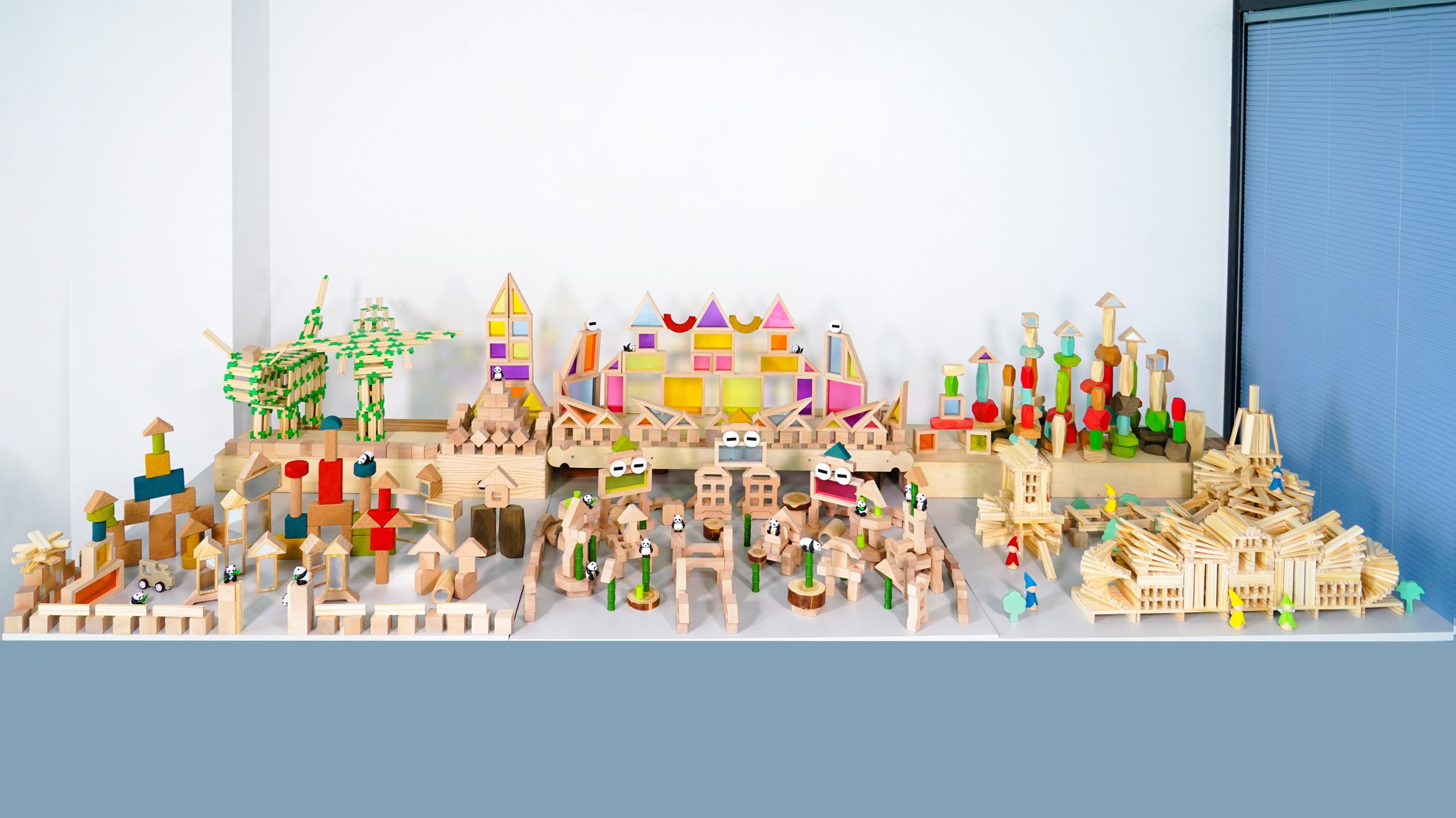
Sing2sky supports distributors, importers, education groups, project suppliers, and OEM brands with wooden educational products and construction systems. Support can include product selection, design, sampling, private-label packaging, manufacturing, inspection, photography, video materials, and export coordination.
Explore our indoor construction systems, review the Sing2sky catalog, or contact our team with your target market, product requirements, and expected order quantities.







