

Classic preschool toys remain valuable in modern early learning environments because they give children direct opportunities to build, sort, match, move, imagine, communicate, and solve problems. Their value does not come from nostalgia. It comes from clear play possibilities that children can revisit at different levels of complexity.
For distributors, importers, preschool groups, and project suppliers, selecting these materials requires more than choosing familiar-looking products. Age suitability, educational purpose, classroom durability, cleaning requirements, safety documentation, packaging, storage, and replacement support should all be evaluated.
This guide introduces 12 timeless categories and explains how professional buyers can select classic preschool toys for contemporary classrooms and B2B product collections.
What Makes a Preschool Toy “Classic”?
A classic toy is not necessarily an old or vintage product. In an educational context, the term usually describes a recognizable play material with a simple function, lasting classroom relevance, and enough flexibility to support repeated use.
Many classic preschool toys share several characteristics:
- Children can understand the basic play possibilities without complicated instructions.
- The product supports active participation rather than passive observation.
- It can be used repeatedly in different activities or play scenarios.
- The level of challenge can change as children gain experience.
- It supports interaction between children, materials, and educators.
- Its educational purpose can be explained clearly to buyers and teachers.
Batteries and electronics do not automatically make a product unsuitable, and a non-electronic toy is not automatically educational. The important question is what children can meaningfully do with the material and whether it is appropriate for their age, abilities, environment, and supervision.
Why Classic Preschool Toys Still Matter
Young children learn through action. They move objects, repeat experiments, observe results, communicate ideas, imitate familiar experiences, and gradually develop more complex play.
The National Association for the Education of Young Children identifies play as an important context for early learning. Its age-and-stage toy guidance also emphasizes selecting materials that match children’s current development and emerging abilities.
Well-selected classic preschool toys can contribute to several learning domains:
- Cognitive development: comparing, predicting, planning, matching, sequencing, and problem-solving
- Fine-motor development: grasping, turning, connecting, threading, stacking, and placing
- Physical development: carrying, pushing, pulling, balancing, and coordinating movement
- Language development: describing actions, telling stories, negotiating roles, and learning new vocabulary
- Social-emotional development: sharing space, waiting, cooperating, expressing ideas, and managing frustration
- Creative development: combining materials and transforming them into new structures or scenarios
No individual toy delivers all these outcomes by itself. Development depends on how the material is introduced, how children use it, how much time they receive, and how educators observe and extend the experience.
12 Timeless Categories of Classic Preschool Toys
1. Stacking Toys
Stacking rings, arches, stones, cups, cylinders, and graduated forms encourage children to compare size, test balance, coordinate their hands, and explore sequence.
The same material may support simple stacking for a younger child and more complex patterning or construction for an older preschooler. Buyers should consider the size and weight of each piece, stability, finish, and recommended age group.

2. Shape Sorters and Matching Toys
Shape sorters invite children to compare outlines, orientations, dimensions, and openings. Matching materials may focus on shapes, colors, objects, textures, quantities, or visual relationships.
Professional buyers should check whether pieces are large enough for the intended age group, whether incorrect pieces can become trapped, and whether the level of challenge matches the target users.
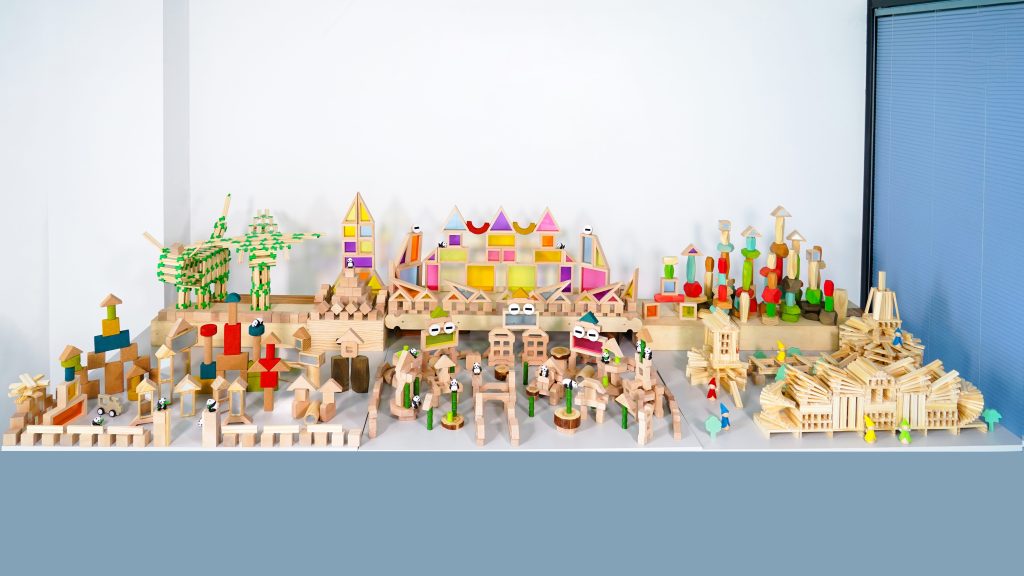
3. Wooden Blocks and Construction Sets
Blocks are among the most versatile classic preschool toys. Children can arrange, enclose, bridge, balance, compare, rebuild, and create shared structures.
Unit blocks use proportional dimensions that allow pieces to relate predictably to one another. Other construction products may use irregular forms, transparent components, connectors, bolts, nuts, tracks, or architectural elements.
Different systems should not all be described as open-ended. A bolt-and-nut engineering set, for example, may offer multiple construction possibilities while still providing a more structured STEM experience than traditional unit blocks.
4. Puzzles
Knob puzzles, inset puzzles, layered puzzles, sequence puzzles, and jigsaw puzzles provide different levels of visual and physical challenge.
Instead of selecting puzzles only by piece count, compare image complexity, piece shape, visual cues, tray design, orientation demands, and the amount of assistance children may need.
5. Counting and Early Mathematics Materials
Counters, number boards, quantity puzzles, pattern tiles, sorting trays, and graduated materials can make abstract mathematical relationships more visible.
These products are most useful when children can handle and compare the components rather than simply memorize a printed answer. They can support classification, correspondence, quantity, pattern, order, and early measurement.

6. Threading, Lacing, and Manipulative Toys
Beads, lacing cards, peg boards, gears, locks, fasteners, and connecting pieces require controlled hand movements. They can support bilateral coordination, visual attention, grip development, and persistence.
Small components require careful age grading and hazard assessment. A manipulative suitable for an older preschool class may be inappropriate for children under three.
7. Vehicles, Roads, and Railway Sets
Wooden vehicles and railway systems combine movement, construction, sequencing, and storytelling. Children can design routes, compare vehicle functions, create destinations, and negotiate shared play scenarios.
For classroom use, buyers should examine wheel and axle durability, track compatibility, connector design, replacement availability, and the size of removable accessories.
8. Dolls, Families, and Play Figures
Dolls and figures can support storytelling, caregiving play, emotional expression, and conversations about families and communities.
A classroom collection should represent people respectfully and avoid restricting certain colors, roles, occupations, or forms of play to one gender. Buyers should also check accessory size, paint durability, fabric care, and cultural relevance.
9. Pretend-Play Equipment
Play kitchens, shops, clinics, workbenches, homes, and transportation settings allow children to recreate and reinterpret familiar experiences.
Effective pretend-play collections do not require large numbers of decorative accessories. A manageable selection of recognizable, adaptable materials often gives children more room to develop their own narratives.
10. Board Games and Cooperative Games
Age-appropriate games can introduce turn-taking, matching, memory, counting, planning, and following shared rules. Cooperative games can also give groups a common goal instead of making every activity depend on one winner.
Buyers should check playing time, language requirements, rule complexity, number of players, component size, and the availability of replacement pieces.
11. Music and Rhythm Materials
Shakers, bells, drums, rhythm sticks, and other simple instruments support listening, coordination, pattern, movement, and group participation.
Sound-producing products should be evaluated for volume, construction, small components, and applicable market requirements. Classroom quantity should also allow meaningful participation without creating an unnecessarily loud environment.
12. Gross-Motor and Balance Materials
Balance boards, stepping pieces, push-and-pull products, tunnels, and modular movement equipment can support whole-body coordination and physical confidence.
These products require careful evaluation of load limits, stability, fall zones, supervision, intended use, age range, and applicable standards. Some large equipment may fall into a different regulatory category from conventional toys.
How to Choose Classic Preschool Toys for a Learning Environment
Purchasing classic preschool toys for institutional or distribution use requires a systematic comparison. The following criteria can help buyers avoid selecting products based only on appearance.
Age and Developmental Suitability
Check the manufacturer’s intended age range, foreseeable use, component size, complexity, required strength, and supervision needs. Age grading is a safety and developmental decision—not simply a marketing label.
Clear Educational Purpose
Ask what actions the product invites. Can children build, compare, classify, connect, tell stories, move, cooperate, or solve a visible problem? Avoid products supported only by vague claims such as “boosts intelligence.”
Durability and Repairability
Classroom products may be handled by many children and moved between shelves, rooms, or sites. Review joints, fasteners, wheels, edges, connectors, surface finishes, fabric seams, and high-stress areas.
Ask whether individual pieces can be replaced. A durable system with available replacement components may provide better long-term value than a lower-priced set that becomes unusable when one essential part is lost.

Cleaning and Storage
Confirm how each material should be cleaned, dried, and stored. Products containing unfinished wood, fabric, paper, magnets, electronics, or glued components may require different procedures.
Storage dimensions matter as well. Large sets may need mobile units, labeled baskets, component trays, or dedicated shelving. Buyers should include storage in the purchasing plan instead of treating it as an afterthought.
Inclusive Representation
Figures, images, role-play materials, and accessories should allow children to encounter different families, occupations, abilities, cultures, and everyday experiences. Colors and play categories should not be restricted by gendered assumptions.
Product Documentation
Professional buyers should request specifications appropriate to the product and destination market, potentially including:
- Product dimensions, materials, and component lists
- Intended age range and warning information
- Cleaning, maintenance, and storage instructions
- Applicable test reports and conformity documentation
- Packaging specifications and carton measurements
- Batch or traceability information
- Installation or assembly instructions when applicable
- Replacement-part information
Are Wooden Toys the Best Choice?
Wood is a popular material for classic preschool toys, but it should not automatically be described as safer or educationally superior to every alternative.
Well-designed wooden products can offer useful characteristics:
- A distinct combination of weight, texture, temperature, and sound
- Strong visual compatibility with natural classroom environments
- Potential for a long service life when construction and maintenance are appropriate
- Stable forms suitable for blocks, puzzles, furniture, and manipulatives
- Opportunities to use responsibly sourced material where documentation is available
However, wooden products can still present hazards if they have unsuitable dimensions, loose components, sharp edges, splinters, unsafe coatings, weak joints, or incorrect age grading. Plastic, metal, textile, and composite products can also be suitable when properly designed, tested, manufactured, and maintained.
Sustainability should be evaluated across material sourcing, manufacturing, finish, packaging, transport, durability, repairability, and end-of-life—not assumed from the material name alone.
Safety and Compliance for Professional Buyers
Safety requirements vary according to the destination market, product category, age grading, materials, and construction. Importers should identify the applicable requirements before approving production.
For the United States, the CPSC’s toy-safety business guidance explains that ASTM F963 contains both generally applicable and toy-specific requirements. Relevant sections may cover small parts, coatings, accessible edges and points, cords, magnets, sound, batteries, and other product features.
For the European Union, manufacturers and importers should review current requirements for placing toys on the EU market, including safety assessment, documentation, labeling, traceability, and CE marking.
A test report should match the actual product configuration, materials, intended age group, and applicable market. Changing a component, coating, supplier, size, or construction method may require a new assessment.
Planning the Right Quantity
There is no universal number of classic preschool toys required for a classroom. A useful quantity depends on:
- Number and age of children
- Classroom size and shelf capacity
- Whether play occurs individually, in small groups, or as a whole class
- Number of classrooms sharing the materials
- Length and frequency of play sessions
- Cleaning and rotation procedures
- Availability of replacement components
- Curriculum and learning-center objectives
Before placing a large order, education groups can test a smaller selection, observe how children use it, and record which components create engagement, congestion, conflict, or unnecessary complexity.
Integrating Classic Toys into the Classroom
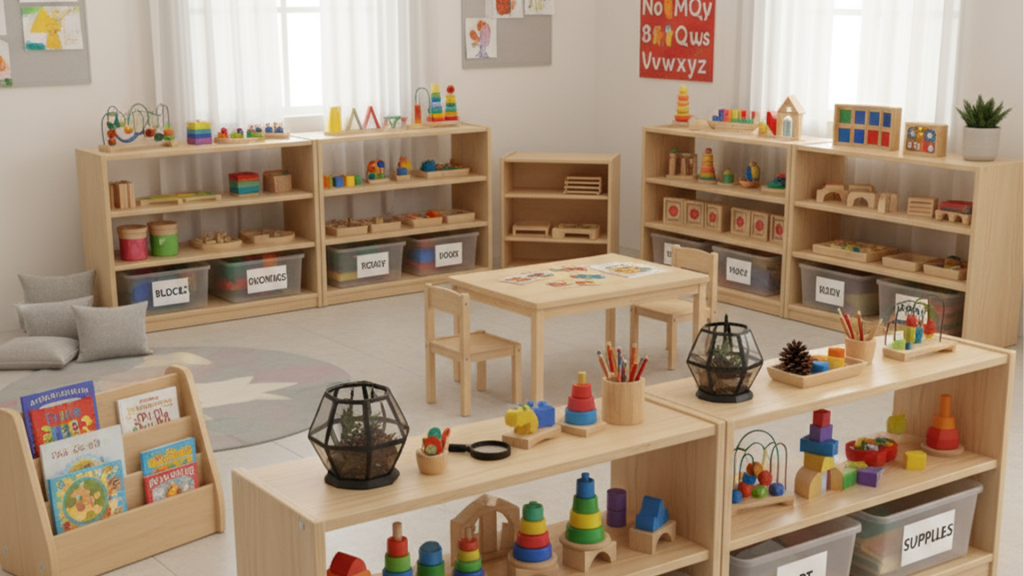
Create Defined Learning Areas
Organize materials into clear areas such as construction, manipulatives, early mathematics, dramatic play, sensory exploration, and movement. This makes it easier for children to find materials and return them after use.
Balance Child-Led and Teacher-Guided Experiences
A block set may be available for child-led construction and later used in a teacher-guided activity about bridges, measurement, or community buildings. The same material can support different teaching approaches without turning every play session into a lesson with one correct answer.
Use Thoughtful Rotation
Rotate materials when observation shows that a collection is creating clutter, receiving little use, no longer matching current learning interests, or needs inspection and cleaning. Rotation does not need to follow a rigid two-week or three-week schedule.
Keep familiar materials available long enough for children to move beyond initial exploration. Removing them too quickly may interrupt more complex play that develops through repetition.
Document How Materials Are Used
Photographs, observation notes, construction records, and children’s explanations can help educators evaluate whether a product supports the intended experience. This information can also guide future purchasing decisions across multiple sites.
Cleaning, Inspection, and Maintenance
Develop a care procedure for each material instead of using one cleaning method for every toy.
- Follow the product manufacturer’s cleaning instructions.
- Separate mouthed, contaminated, or damaged pieces from available materials.
- Do not automatically soak wooden products or place them in a dishwasher.
- Allow cleaned items to dry completely before storage.
- Use sanitizers or disinfectants only when appropriate for the surface and required by facility policy.
- Inspect for cracks, splinters, loose parts, exposed fasteners, damaged seams, peeling coatings, and missing components.
- Remove damaged pieces from use until they are replaced or assessed.
- Do not automatically sand, repaint, oil, or modify a children’s product without manufacturer guidance.
The Head Start cleaning schedule recommends following label directions when cleaning wooden classroom toys. Local childcare rules and public-health requirements should also be considered.
B2B Sourcing Checklist for Distributors and Importers
When adding classic preschool toys to a wholesale, project, or private-label range, evaluate both the product and the supplier.
- Does the supplier provide consistent product specifications?
- Can materials and finishes be identified clearly?
- Are applicable test reports available for review?
- Can packaging, labeling, and instructions be adapted for the target market?
- Are carton dimensions, weights, and loading data available?
- Can several product categories be consolidated into one order?
- Are samples available before bulk production?
- Can replacement components be supplied?
- Does the supplier provide quality inspections and production records?
- Are product photographs, videos, and sales materials available?
- Can the manufacturer support OEM or private-label development?
- Are changes documented and approved before production?

Sing2sky works with distributors, importers, education groups, project suppliers, and OEM brands. Our support can include product selection, 2D and 3D design, sampling, private-label packaging, manufacturing, inspection, photography, video materials, and export coordination.
Explore our educational product collections or learn more about Sing2sky’s manufacturing capabilities.
Frequently Asked Questions
What are classic preschool toys?
They are enduring play materials such as blocks, puzzles, stacking toys, shape sorters, vehicles, dolls, manipulatives, pretend-play equipment, and simple games. Their value comes from clear, active play possibilities rather than their age or appearance.
Are classic toys always open-ended?
No. Traditional blocks and play figures may be highly open-ended, while puzzles, shape sorters, Montessori materials, and mechanical construction sets may have clearer objectives or constraints. Both types can have educational value when selected appropriately.
Are wooden toys safer than plastic toys?
Not automatically. Safety depends on product design, component size, materials, coatings, construction, age grading, testing, labeling, maintenance, and intended use. Both wooden and plastic toys can be safe when they meet the applicable requirements.
How many toys should a preschool classroom have?
There is no universal number. Quantity should reflect enrollment, room size, group organization, storage, cleaning procedures, curriculum goals, and how children actually use the materials.
How often should classroom toys be rotated?
Rotate them according to observation rather than a fixed calendar. Maintain materials long enough for children to develop more complex play, but remove or replace items that create clutter, receive little use, need cleaning, or no longer support current learning interests.
How should wooden preschool toys be cleaned?
Follow the manufacturer’s instructions. Many wooden products should be wiped rather than submerged and must dry completely before storage. Sanitizing or disinfecting procedures should be compatible with the material and follow applicable facility requirements.
Should buyers choose Montessori or traditional toys?
The choice should follow the program’s educational approach. Montessori materials have specific purposes and presentation methods, while other traditional toys may support construction, dramatic play, cooperation, or broader open-ended exploration.
Can classic preschool toys be customized for a distributor?
Depending on the product and order requirements, customization may include branding, colors, components, product combinations, packaging, instructions, and sales materials. Minimum quantities and testing implications should be confirmed before development.
Build a Timeless, Practical Product Collection
Classic preschool toys remain relevant because they support actions central to early learning: building, sorting, moving, matching, imagining, communicating, and collaborating.
The best institutional or wholesale collection is not necessarily the largest. It is a coordinated selection that matches children’s development, serves clear learning purposes, fits the available environment, withstands expected use, and is supported by appropriate documentation.
Distributors, importers, education groups, and OEM brands can review the Sing2sky catalog or contact our team to discuss product selection, mixed-category sourcing, private-label packaging, and educational toy development.







