

Plant activities bring early science into everyday classroom experiences. Children can sow a seed, notice a new root, compare leaves, and describe changes in their own words. These small investigations also create opportunities for counting, drawing, conversation, and shared care. This guide introduces 12 practical ideas for preschool and kindergarten, with classroom setup tips and guidance for selecting planting materials.
Why Include Plant Activities in Early Education?
A growing plant gives children something real to revisit. They can make a prediction, observe what happens, and compare today’s plant with yesterday’s drawing. Changes may be slow or unexpected, which creates useful questions rather than a guaranteed result.
Keep explanations connected to what children can observe. Start with roots, stems, leaves, moisture, and growth before introducing more detailed terminology. Accept drawings, gestures, and spoken descriptions as ways to share discoveries.
KidsGardening’s indoor seed planting resource provides practical guidance on preparing materials and adapting participation. Follow the seed packet’s instructions, since planting depth and growing conditions vary between species.
12 Fun Plant Activities for Preschool and Kindergarten
Choose plant activities that fit your growing conditions, available space, and children’s interests. The ideas below can be used individually or developed into a longer classroom project. Adult preparation and supervision should reflect the materials and participants involved.
1. Start a Seed in a Container
Set up: Prepare suitable seeds, clean containers with drainage, trays, and an appropriate growing medium. Adults should handle cutting or making drainage holes.
Try it: Children help fill the container and sow seeds according to packet instructions. Label the container with a picture, name, and planting date. Keep seeds out of mouths and wash hands after handling soil.
Ask: “What do you think we might notice first?”
2. Observe Germination Through a Clear Window
Set up: Use a suitable transparent observation container, or an adult-managed clear bag with a damp paper towel and seeds selected for the investigation. Keep bags and loose seeds under adult control.
Try it: Look for changes in the seed coat, root, and shoot. Keep the towel moist rather than waterlogged. Once seedlings need more room, transfer them to an appropriate growing medium. Adults should remove any moldy samples.
Ask: “Which part changed since our last look?”

3. Keep a Plant Observation Journal
Offer plain paper, drawing tools, and a place to display observations. Children can draw the same plant on several occasions while an adult records their descriptions. Use dates or simple sequence labels to help revisit earlier entries.
Ask: “What would you like to include in today’s drawing?”
4. Sequence a Flowering Plant’s Life Cycle
Use photographs of one familiar flowering plant to explore seed, seedling, mature plant, flower, and new seed stages. Let children arrange the images and explain their choices. Some stages may take longer than the classroom project, so distinguish photographs from changes the group has actually observed.
A suitable seed puzzle can complement observation by introducing parts of a seed. Choose supporting materials according to their intended age group.
Ask: “Which picture shows something we have already seen?”
5. Explore Leaves and Plant Parts
Choose known plants assessed as suitable for the group. Observe leaf shape, veins, stems, and roots where visible. Use large photographs or adult-selected samples for comparison, and avoid picking or handling unidentified plants.
Ask: “What is similar about these two leaves? What is different?”
6. Investigate Water Movement With Celery
An adult prepares fresh celery stalks and places them in stable, nonbreakable containers of water, adding food coloring to one container. Keep a plain-water comparison where possible. Observe color changes over time; results vary with the celery and conditions.
The Science Buddies water transport lesson explains this investigation. Colored water can make its movement through the stalk easier to see. It does not demonstrate photosynthesis or show how an intact root system absorbs water. Adults handle cutting, and experiment materials should not be eaten.
Ask: “Where can you see the color now?”
7. Observe Plants in Different Light Conditions
Choose comparable plants and two locations with different light levels. Keep other care conditions as similar as practical and record differences over time. Avoid assuming that the brightest or hottest window is best for every species.
Explain that green plants use light to make food, while many seeds begin germination using stored resources. A simple location comparison explores responses to growing conditions; it is not a direct measurement of photosynthesis. Do not promise a particular change within a fixed number of days.
Ask: “What can we notice about each plant?”
8. Compare Plant Height
Photograph or draw a seedling beside the same fixed reference on several occasions. Older children can use a clearly marked ruler with adult support, measuring from the same starting point each time. Avoid bending or stretching the plant.
Ask: “How can we compare today’s height with our earlier record?”
9. Count and Compare Leaves
Count visible leaves on selected plants without removing them. Children can represent each leaf with a drawn mark or picture card and compare their records. Discuss whether the group is counting every leaf or only fully opened leaves.
Ask: “How could we keep track of the leaves we have counted?”
10. Make Plant Labels and Care Signs
Invite children to draw labels, dictate plant names, or create picture reminders for care tasks. Writing does not need to be conventional to have a purpose. An adult can add accurate plant information alongside children’s contributions.
Ask: “What would help someone recognize this plant?”
11. Create a Small Sensory Planting Area
Plan a small collection for looking, smelling, and, where suitable, touching. Select species with local horticultural advice, considering toxicity, thorns, irritating sap, allergies, and the children using the area. Introduce each plant before exploration.
Offer participation without touch or strong scents for children who prefer it. Any tasting should be a separate, planned food activity using positively identified edible plants and the setting’s allergy and food-handling procedures.
Ask: “How would you like to explore this plant?”

12. Revisit a Plant on a Nature Walk
Choose a known plant along a supervised route and return to it over time. Children can notice new leaves, flowers, fallen material, or seasonal changes. Use drawings and photographs rather than collecting unfamiliar specimens.
Ask: “What has changed since our last visit?”
Building Plant Activities Into Classroom Routines
Keep care routines short and purposeful. Children can help check growing conditions, record a change, or prepare materials while adults remain responsible for appropriate plant care.
- Check before watering: Water according to the plant and growing medium, rather than automatically adding water every day.
- Share roles: Offer observing, drawing, labeling, and watering tasks so participation is not limited to handling soil.
- Plan ongoing care: Assign adult responsibility for weekends, holidays, and periods when the classroom is closed.
- Discuss unexpected results: A seed that does not sprout can prompt questions about conditions without blaming a child.
Preparing an Accessible Plant Learning Area
Plant activities can begin with a few containers; a large garden is optional. Choose stable work surfaces, clear walking routes, reachable materials, and drainage arrangements that prevent spills from creating slippery areas.
For outdoor planting, assess the site, growing medium, sunlight, water access, and storage. Raised beds are accessible only when their height, reach distance, and surrounding paths suit the people using them. Keep fertilizers, pesticides, sharp tools, and other adult supplies securely stored.
Provide handwashing after gardening and before eating. Keep soil and experimental materials separate from food activities. Use pictures, home-language labels, and flexible working positions to support different learners.
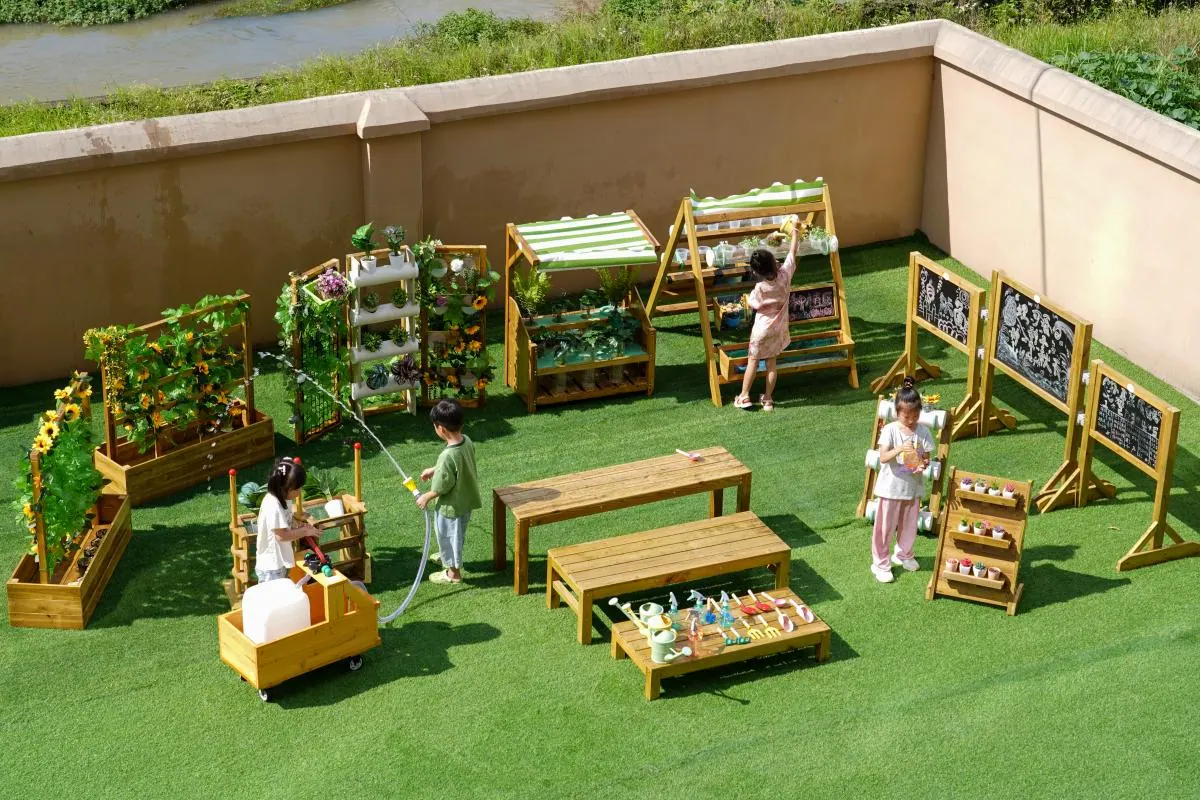
Choosing Equipment for Plant Activities
Distributors, importers, education groups, and project suppliers should begin with the activities and site requirements. Match planting containers, observation equipment, storage, and work surfaces to those needs.
- Confirm dimensions, working heights, intended age group, and component weights.
- Check stability, drainage, water exposure limits, and installation requirements.
- Request material and finish details relevant to the intended use, including edible planting where applicable.
- Review product documentation for the destination market and product category.
- Discuss cleaning, inspection, storage, replacement components, and OEM or ODM options.
Wooden equipment can provide useful planting and storage structures, but outdoor durability and suitability depend on design, treatment, exposure, and maintenance. Avoid assuming that wood is automatically non-toxic, weatherproof, or suitable for every growing project.
Explore Sing2sky’s outdoor planting area collection when preparing a project brief. Confirm the specifications of the exact products under consideration.
Frequently Asked Questions About Plant Activities
What are easy plant activities for preschoolers?
Start with planting a suitable seed, observing leaves, drawing a seedling, or making a plant label. A small collection allows children to revisit changes without requiring a large garden.
How long does a seed take to sprout?
Timing varies with species, seed condition, temperature, moisture, and other requirements. Use the packet’s expected germination range and record what actually happens.
Do all seeds need sunlight to germinate?
No. Light requirements for germination vary between species. Follow the seed instructions, and distinguish those requirements from the light a growing green seedling needs.
Can plant activities work without an outdoor garden?
Yes. Suitable indoor containers, observation journals, photographs, and plant-part materials can support a classroom project. Choose plants that suit the available indoor conditions.
Can children taste plants from a sensory garden?
Do not make tasting part of unrestricted exploration. Plan it separately using identified edible plants, appropriate preparation, and the setting’s food and allergy procedures.
Start Small and Follow Children’s Questions
Meaningful plant activities give children something to notice, revisit, and discuss. Begin with one growing project, record its changes, and let children’s questions help shape the next investigation.
Sing2sky works with distribution, OEM, and education project partners sourcing educational play and planting materials. Browse our product range or catalog to explore suitable collections.
For wholesale, OEM, or project requirements, contact Sing2sky with your destination market, intended age group, space requirements, and quantities. Schools and early learning centers can inquire about suitable local distribution partners.







