

Preschool classroom toys influence how children explore, communicate, move and solve problems throughout the day. A balanced classroom collection should provide different forms of play without overwhelming the learning environment with unnecessary products.
For preschool groups, educational distributors and importers, selecting suitable preschool classroom toys involves more than choosing attractive colours or popular themes. Buyers should consider age grading, educational purpose, component design, safety documentation, storage, cleaning and replacement support.
This guide introduces the main classroom toy categories and ten practical checks for planning a safe, useful and commercially sustainable preschool collection.
Why Preschool Classroom Toys Matter
Classroom toys are working materials within a play-based environment. Depending on their design and use, they can create opportunities for construction, sorting, role play, movement, sensory exploration and communication.
The National Association for the Education of Young Children recommends matching toys and play materials to children’s developmental stages and emerging abilities. The same principle applies when professional buyers plan a classroom collection: products should be selected for their intended users and purpose, not simply because they are labelled “educational.”
Well-planned preschool classroom toys can support several types of activity while remaining understandable, accessible and practical to maintain. The educational value still depends on how the materials are introduced and how children interact with them.
Essential Categories of Preschool Classroom Toys
A complete preschool range should not depend on one product type. Combining complementary categories helps educators create different learning areas without expecting every toy to support every developmental goal.
Blocks and Construction Materials
Wooden blocks, large building components, stacking sets and mechanical construction systems can support spatial exploration and design thinking. Open-ended blocks offer flexible building possibilities, while interlocking or bolt-and-nut sets introduce specific connection methods.
Buyers should compare shapes, dimensions, component quantities, storage and compatibility rather than relying only on total piece count.

Sensory and Fine-Motor Materials
Sorting pieces, puzzles, threading activities, pegboards and textured blocks invite children to grasp, place, compare and organise objects. Component size and complexity should be appropriate for the product’s intended age range.

Dramatic and Role-Play Resources
Play kitchens, market stands, dolls, puppets and occupational props can provide a context for storytelling and shared play. When selecting these preschool classroom toys, buyers should consider whether the collection reflects varied families, roles and community experiences.
Mathematics and Early STEM Materials
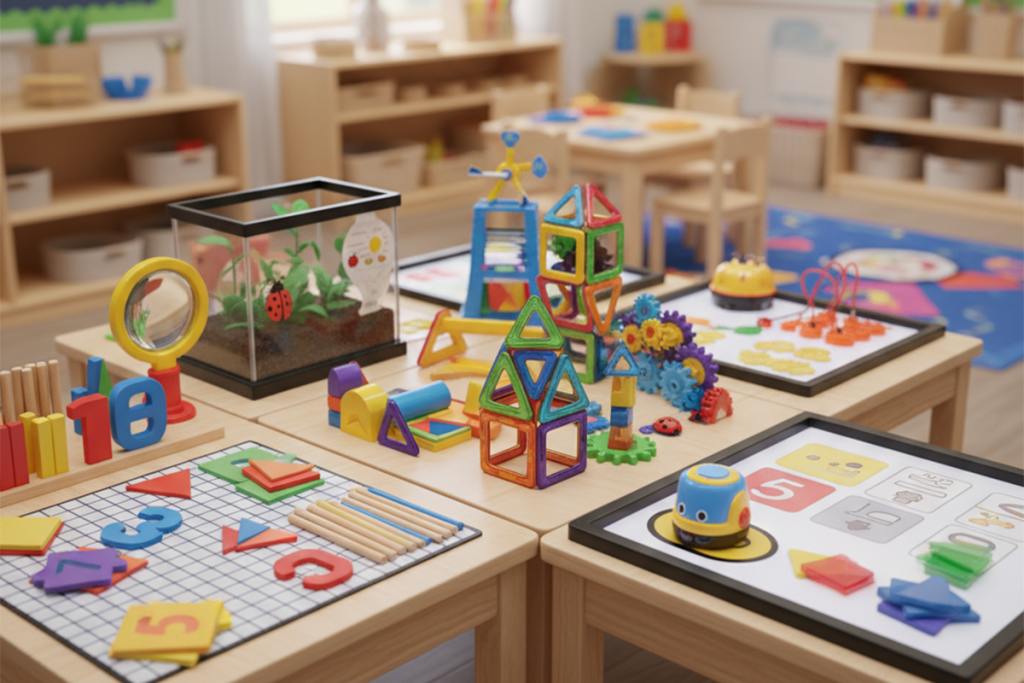
Counting objects, pattern blocks, measuring tools, simple scales and mechanical building sets can support discussion about quantity, shape, sequence, balance and movement.
The Preschool Architectural & Railway Wooden Building Blocks Set is one example of a construction resource designed around hands-on building activities.
Gross-Motor and Active-Play Equipment
Balance equipment, climbing components, movement sets and lightweight large blocks serve a different purpose from tabletop toys. Buyers must confirm intended use, supervision, installation, activity space and whether the product is designed for indoor or outdoor conditions.
Sand, Water and Investigation Materials
Trays, scoops, containers, channels and water-flow components can support filling, pouring, transferring and experimentation. Drainage, cleaning, material resistance and storage are important purchasing considerations.
Classroom Furniture and Storage
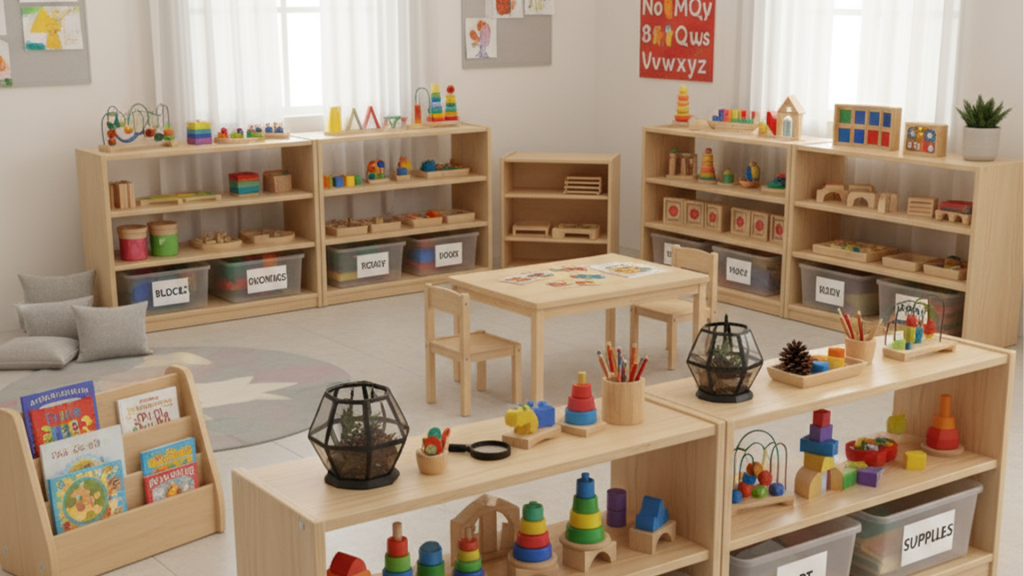
Furniture is not a toy category, but it affects how successfully preschool classroom toys are presented and managed. Low shelving, labelled containers and clearly defined activity areas can make materials easier to access and return.
10 Best Tips for Selecting Preschool Classroom Toys
The following ten checks help professional buyers compare classroom collections, samples and supplier proposals.
1. Start with the Intended Age Range
Confirm the manufacturer’s age grading, instructions and warnings. Products that look similar may have different component sizes, weights or intended play patterns.
2. Define the Educational Purpose
Decide whether the product is intended for construction, role play, sensory exploration, movement, mathematics or another classroom function. Avoid making one toy responsible for too many unrelated learning claims.
3. Balance Open-Ended and Structured Materials
Open-ended materials allow varied uses, while structured toys introduce particular rules, sequences or connection methods. A balanced collection can include both.
4. Review the Complete Product Specification
Request confirmed materials, dimensions, component quantities, colours, finishes, packaging and assembly information. Photographs alone are not a complete product specification.
5. Check Classroom Quantity and Group Use
There is no universal number of pieces required for every class. Estimate how many children will use the materials, whether they will work individually or collaboratively and how many activities may take place simultaneously.
6. Inspect a Representative Sample
Evaluate finish, component fit, stability, handling, assembly, instructions and packaging before confirming a bulk order. Record the approved sample and specification for production control.
7. Plan Storage Before Purchasing
Large sets can become difficult to use if their components cannot be sorted or counted efficiently. Review container size, shelf space, mobility, labels and replacement storage.
8. Verify Safety Documentation
Request documents applicable to the selected model, intended age and destination market. Confirm that customised materials or components remain within the tested specification.
9. Check Cleaning and Maintenance Requirements
Confirm how each material should be cleaned and whether parts can tolerate the intended institutional cleaning routine. Different wood finishes, fabrics, plastics and metal components may require different methods.
10. Evaluate Replacement and Expansion Support
Ask whether lost connectors, damaged parts or frequently used components can be reordered. For modular ranges, confirm whether future expansion sets will remain compatible.
Safety Checks for Preschool Classroom Toys
Safety requirements depend on the product design, intended age and destination market. A general claim such as “safety certified” does not explain which model was tested or which requirements were assessed.
The U.S. Consumer Product Safety Commission’s toy safety guidance addresses issues including small parts, accessible edges, points, fasteners and other product-specific requirements. Importers should identify every applicable rule for the actual product.
- Component size: Review small parts and detachable components in relation to the intended age.
- Accessible surfaces: Inspect edges, points, holes, joints and fasteners before and after normal handling.
- Materials and coatings: Confirm the actual substrate, paint, finish, adhesive and plastic components.
- Stability: Review products intended to stand, support components or move during play.
- Instructions and warnings: Ensure age markings and use restrictions remain consistent across product, packaging and manuals.
- Traceability: Confirm model, production and batch information required by the destination market.
For products intended for children under three in the United States, the CPSC provides specific small-parts guidance. Buyers should not substitute a visual estimate for the required assessment and testing.
The Role of Wooden Toys in a Classroom Collection
Wooden blocks, puzzles, role-play furniture and manipulatives can form an important part of a classroom range. Their weight, texture and construction characteristics differ from plastic, fabric or foam products.
Wooden preschool classroom toys are not automatically safer, more sustainable or more durable simply because they are made from wood. Buyers should confirm the wood species or board type, moisture control, joining method, surface finish, intended use and supporting documentation.
FSC certification, where applicable, supports particular responsible forestry and chain-of-custody claims. It does not replace toy safety testing or establish that a coating is non-toxic.

Creating Effective Classroom Learning Areas
The arrangement of preschool classroom toys affects whether children can find the materials, understand where they belong and participate in cleanup.
Head Start guidance on responsive learning environments highlights the value of accessible materials that reflect children, families and communities. Classroom planning should therefore consider both physical access and representation.
Use Clearly Defined Areas
Separate active movement equipment from quiet tabletop activities. Construction, dramatic play, sensory and reading areas may require different floor space, furniture and supervision.
Make Materials Visible
Low shelves, open-front containers and picture labels can help children identify choices. Heavy or adult-managed products should be stored according to their handling requirements.
Avoid Overloading the Environment
Displaying every available product at once can make selection and cleanup difficult. Present a purposeful group of materials and store the remainder for later rotation.

Rotation, Inclusion and Classroom Use
Rotate Materials with a Purpose
Rotation should respond to children’s interests, current classroom projects, available space and the condition of the products. A familiar toy can also be presented with different accessories instead of being replaced.
Balance Child-Led and Guided Experiences
Children need time to investigate materials without a required outcome. Educators can later introduce questions, stories or practical challenges that extend the activity while leaving room for children’s decisions.
Consider Different Ways to Participate
Inclusive preschool classroom toys should offer more than one possible form of participation. Buyers can review component grip, visual contrast, product weight, working height and whether activities can be adapted without changing the product’s safe use.
Represent Varied Communities
Figures, role-play resources, images and classroom stories should avoid presenting one family structure, culture, occupation or gender role as universal. Representation should be accurate and respectful rather than added only as decoration.
Cleaning, Inspection and Replacement
Institutional preschool classroom toys require a maintenance system appropriate to their materials and frequency of use.
- Follow the manufacturer’s cleaning instructions for each material and finish.
- Remove cracked, rough, deformed or incomplete components from use.
- Check fasteners, connectors, wheels and moving parts at suitable intervals.
- Allow cleaned products to dry fully before returning them to storage.
- Record missing essential pieces and order replacements where available.
- Keep different sets separated when mixing their components could affect safe use.
See our practical guide on how to clean wooden blocks for additional care considerations.
Evaluating a Preschool Toy Supplier
For distributors and educational buyers, supplier evaluation should cover repeat-order consistency as well as the first sample.
- Product specification: Materials, dimensions, quantities, colours, packaging and instructions.
- Sample approval: A recorded reference before bulk production.
- Quality controls: Checks for machining, finish, assembly, components and packing.
- Documentation: Reports and records relevant to the product and destination market.
- Change control: Communication before materials or functional components are changed.
- Replacement support: Availability of individual components and after-sales information.
- Logistics: Carton dimensions, weights, packing quantities and assembly requirements.
Founded in 2008, Sing2sky develops wooden educational toys, preschool furniture, infant and toddler equipment, sensory resources and outdoor play systems for distributors, importers, preschool groups and OEM brands.
Available cooperation may include product selection, coordinated classroom collections, OEM or private-label packaging, sampling and promotional materials. Review our educational product range and manufacturing capabilities when planning a project.
Frequently Asked Questions
What are the best preschool classroom toys?
The best collection depends on the children’s ages, classroom goals, available space and supervision. A balanced range may include blocks, role-play resources, sensory materials, puzzles, STEM manipulatives and suitable movement equipment.
How many toys does a preschool classroom need?
There is no universal number. Quantity should reflect group size, the scale of each product, whether children will work together and how materials will be rotated. More products do not automatically create a better learning environment.
Are wooden toys better for preschool classrooms?
Wood offers particular weight, texture and appearance, but it is not automatically better than every other material. Buyers should compare the complete product design, finish, maintenance, intended use and supporting documentation.
Should classroom toys be open-ended?
Open-ended materials are valuable because they can support varied uses, but structured puzzles, games and mechanical sets can also serve clear purposes. A balanced classroom collection can include both approaches.
Can preschool toys be customised for an OEM range?
Branding, colours, packaging and selected configurations may be customisable. Changes to materials, dimensions or functional components should be reviewed for their effect on use and applicable testing.
Conclusion
The strongest preschool classroom toys collection is not necessarily the largest. It is a coordinated group of materials selected for clear purposes, appropriate users and realistic classroom conditions.
Professional buyers should compare age grading, specifications, safety documentation, storage, maintenance and replacement support alongside price. A representative sample and approved written specification provide a stronger foundation for bulk purchasing than photographs or general marketing claims alone.
Explore the complete Sing2sky catalogue, or contact us to discuss classroom collections, wholesale purchasing and OEM cooperation.







