

Reggio Emilia vs Montessori is a useful comparison for educators planning an early childhood program. Both approaches take children’s capabilities seriously, but they organize learning, materials, and the teacher’s work in different ways.
Understanding these differences helps education groups, classroom designers, and educational distributors make more informed decisions. The goal is to connect the philosophy with everyday practice: what children can choose, how teachers respond, and which resources belong in the environment.
This guide explores seven practical insights into Reggio Emilia vs Montessori, including classroom examples, material selection, and questions to consider before developing a program.
Understanding Reggio Emilia and Montessori
What Is the Reggio Emilia Approach?
The Reggio Emilia Approach developed through the educational work of the Italian city of Reggio Emilia, with Loris Malaguzzi playing a central role. It views children as capable participants who develop ideas through relationships and many forms of expression.
The official Reggio Children introduction identifies documentation, family participation, the environment as educator, and the atelier as important elements. The atelier is a space for investigation through expressive materials, supported in the municipal educational project by an atelierista.
Outside its original context, “Reggio-inspired” is a useful description for programs drawing on these ideas. A collection of loose parts or an attractive art area alone does not represent the complete approach.
What Is Montessori Education?
Developed by Maria Montessori, Montessori education combines child-directed activity with a prepared environment and carefully introduced learning materials.
The American Montessori Society’s five core components are trained Montessori teachers, mixed-age classrooms, Montessori materials, child-directed work, and uninterrupted work periods. These elements function together; purchasing materials is only one part of implementation.
Reggio Emilia vs Montessori at a Glance
| Area | Reggio-inspired practice | Montessori practice |
|---|---|---|
| Learning planning | Investigations develop through children’s ideas and teachers’ interpretation. | Teachers introduce a sequence of activities according to readiness. |
| Teacher’s role | Researches, documents, and develops investigations with children and colleagues. | Observes, presents materials, and guides choices within the prepared environment. |
| Materials | Resources are selected to explore questions and represent ideas. | Specialized materials support purposeful activity and progression. |
| Working together | Dialogue and shared inquiry are prominent. | Individual concentration, partner work, and mixed-age learning coexist. |
| Environment | Spaces evolve with investigations and support expressive work. | Accessible, orderly spaces support independent activity. |
| Documentation | Makes thinking visible for interpretation and revisiting. | Informs presentations, learning progression, and individual support. |
| Family relationships | Participation is part of the educational project. | Communication and shared understanding support the child’s development. |
This Reggio Emilia vs Montessori overview describes broad emphases. Actual practice depends on teacher preparation, program quality, and the local setting.
1. Curriculum: Responsive Investigation and Learning Sequences
A Reggio-inspired investigation can begin with a question children raise. Teachers listen, consider possible directions, and provide experiences that help the group develop its ideas.
The Reggio concept of progettazione, or designing, involves thoughtful planning that remains open to what emerges. Teachers actively shape conditions for inquiry.
In Montessori early childhood education, teachers introduce materials within a curriculum sequence while responding to each child’s readiness. Children choose among available activities and can return to them repeatedly.
Planning implication: Ask how the program will balance children’s choices, educator intentions, and local curriculum expectations. Document this clearly before preparing a purchasing list.
2. Teachers: Observation Leads to Different Responses
Both approaches require attentive adults. In a Reggio-inspired setting, teachers may revisit children’s comments with colleagues, introduce a new material, or invite the group to examine different explanations.
A Montessori teacher may use observation to decide when to demonstrate an activity, offer an extension, or provide support. The teacher prepares conditions that allow children to work with increasing independence.
Classroom example: When a child encounters difficulty, the educator considers what kind of response will help. This might be a question, a presentation, an environmental adjustment, or time to try again.
The Reggio Emilia vs Montessori comparison is therefore about how adults support learning, rather than how much they withdraw from the classroom.
3. Materials: Inquiry Resources and Purposeful Learning Tools
Reggio-inspired projects may use blocks, clay, drawing tools, fabrics, photographs, or light-and-shadow resources. Selection follows the investigation: what could help children test an idea or express a theory?
Montessori materials commonly have defined presentations and relationships to other activities. Many include a control of error that helps children recognize a mismatch or check their work.
Selection implication: Open-ended reflective blocks can support an investigation, but they should not automatically be described as standard Montessori materials. Likewise, a wooden finish does not establish educational authenticity.

4. Independence and Collaboration Belong in Both Approaches
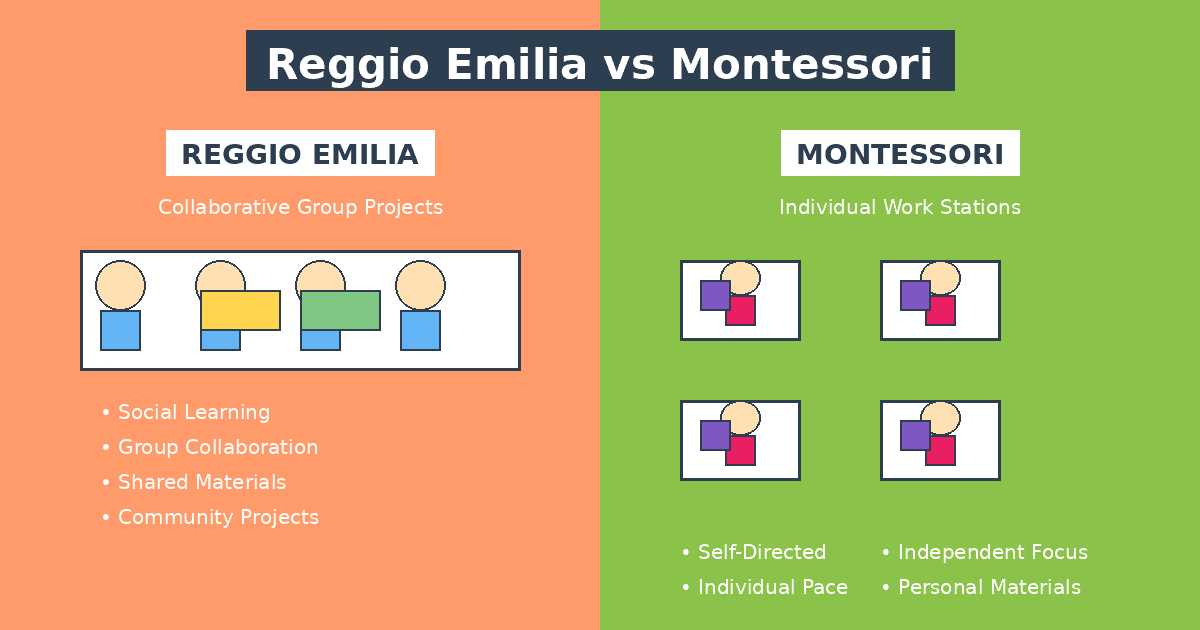
One common misconception in Reggio Emilia vs Montessori discussions is that one approach is social and the other is solitary.
Reggio places strong emphasis on relationships and shared meaning-making, while individual expression remains valuable. Montessori supports independent activity alongside cooperation, partner work, and learning from peers.
The American Montessori Society describes early childhood classrooms where children work individually or in small groups. Mixed-age communities also create opportunities to observe, help, and learn from others.
Design implication: Provide places for focused activity and spaces for working together. Observe how children use each area before deciding that the room needs more individual tables or larger shared surfaces.
5. Environments: Educational Purpose Comes Before Appearance
Both approaches give the environment an educational role. A Reggio-inspired setting may need adaptable project surfaces, expressive materials, and ways to revisit investigations.
A Montessori environment requires accessible materials, suitable furniture, and an arrangement that enables children to choose activities and restore them after use.
Natural wood, neutral colors, or large windows can contribute to a room’s appearance, but they do not demonstrate how learning happens. Ask whether children can reach resources, move comfortably, find complete activities, and participate with appropriate adaptations.

6. Documentation: Make Observations Useful
In Reggio-inspired practice, documentation supports interpretation. Educators revisit selected conversations, drawings, and photographs to understand children’s ideas and consider possible next steps.
Montessori teachers also observe and record learning. Their notes inform future presentations, progression, and support for individual children.
Practical question: What will the team do with the information it collects? A useful record should inform discussion, planning, or communication rather than simply fill a display board.
Agree on manageable recording routines and appropriate consent for photographs. Choose documentation tools according to those routines.
7. Implementation: Prepare the Team Before Buying the Room
The most useful Reggio Emilia vs Montessori decision connects educational intentions with staffing, time, and resources. Materials should follow that decision.
For a Reggio-inspired program, identify how staff will study documentation, plan investigations, and work with families. For a Montessori program, confirm age-level teacher preparation, material requirements, and uninterrupted activity periods.
Build the project brief around:
- Educational practice: Describe what children and adults will do each day.
- Staff development: Include training, mentoring, and collaborative planning time.
- Materials: Specify complete sets, dimensions, and intended activities.
- Access and care: Plan storage, cleaning, maintenance, and adaptations.
- Family communication: Explain the program’s choices and participation opportunities.
- Budget: Include furniture, consumables, freight, and replacement needs.
A Practical Example: Exploring Size
Consider how a question about size could take different directions.
A Reggio-inspired invitation: Children compare structures they have built and discuss what “bigger” means. The educator might offer drawing materials or photographs to explore whether they mean taller, wider, or able to hold more objects.
A Montessori presentation: A trained educator introduces an appropriate graded material, demonstrating its arrangement. The child can repeat the activity and explore its relationships within the intended presentation.
These are illustrative examples, not complete descriptions of either approach. They show why the same purchasing category—such as size-related resources—can require different product specifications.
Reggio Emilia vs Montessori: Which Fits Your Program?
Assess the practices your team can sustain. If shared investigation, documentation, and expressive inquiry are central intentions, study Reggio-inspired implementation in depth.
If the team intends to implement Montessori, plan for the complete educational framework, including teacher preparation and the organization of work. Avoid choosing either approach mainly for its classroom appearance.
A blended program needs an explicit explanation of its choices. Identify which practices you are adopting, how they fit together, and how you will describe the program accurately to families.
Frequently Asked Questions
What is the main difference between Reggio Emilia and Montessori?
A useful distinction is how learning is organized: Reggio-inspired practice develops investigations through dialogue and interpretation, while Montessori combines child choice with sequenced materials and presentations. Both involve observation and intentional teaching.
Does Montessori include collaborative learning?
Yes. Children may work with partners and learn from peers. Independent concentration is important, but it exists within a classroom community.
Is Reggio-inspired education mainly about art?
No. Expressive materials help children investigate and communicate ideas. The approach also involves relationships, research, environment design, documentation, and participation.
Can the same wooden materials serve both settings?
Some furniture and general resources may suit both, but specialized materials require closer review. Confirm the intended presentation or investigation before assuming that a product fits either philosophy.
Plan Educational Materials with Sing2sky
For educational distributors, importers, education groups, and project suppliers, the Reggio Emilia vs Montessori comparison helps turn a broad philosophy into a clearer product brief.
Sing2sky manufactures wooden educational products and supports wholesale and OEM/ODM discussions. Explore our product collection and catalog to identify resources for your project.
Contact Sing2sky with your target market, intended age group, teaching approach, and estimated quantities. Review shortlisted materials with the educational team before confirming the final specification.







