

Large-scale wooden construction systems give children opportunities to plan, connect, test and rebuild structures using components they can handle together. Compared with small tabletop building materials, these systems introduce a more physical form of construction play that can combine STEM exploration, communication and movement.
However, selecting an appropriate system requires more than comparing the number of pieces. Educational distributors, importers and preschool buyers should also review the component design, connection method, intended age range, storage, replacement support and documentation for the destination market.
This guide explains how large wooden building systems can be used in educational environments, what buyers should evaluate and how an experienced manufacturing partner can support a coordinated mechanical construction range.
What Is a Large-Scale Wooden Construction System?
A large-scale wooden construction system generally combines planks, panels, wheels, connectors, bolts, nuts and other mechanical components. Children can arrange and connect the pieces to create structures such as vehicles, frames, workstations, bridges or imaginative play settings.
Some systems focus on simple joining activities, while more advanced configurations may introduce moving parts, gears, axles, pulleys or different connector types. The exact components and possible uses depend on the selected model.

These products are often described as open-ended because they do not limit children to one finished model. Nevertheless, the amount of guidance varies between products. Some sets support completely free construction, while others include activity cards or suggested models that introduce particular mechanical ideas.
How Wooden Construction Systems Support Learning
The learning value of a construction system depends on its design, the way educators introduce it and the opportunities children receive to revisit their ideas. The material itself should support exploration rather than promise a guaranteed developmental result.
Planning, Testing and Revising
Construction play gives children a visible problem to solve. They choose components, decide how to connect them and observe whether the result works as intended.
If a structure leans, a wheel does not turn or two components cannot be joined, children can reconsider the design. This cycle of building, testing and revising introduces an age-appropriate form of engineering thinking.
Mechanical and STEM Exploration
Bolts, nuts, wheels, axles and other functional parts allow educators to discuss practical concepts such as connection, movement, rotation, balance and stability. More complex sets may also support investigations involving gears, pulleys or different forms of motion.
Mathematical language can be introduced naturally as children count components, compare lengths, identify shapes, estimate distance or discuss the position of different parts.
Communication and Collaboration
Larger projects can create a reason for children to work together. They may need to describe an idea, locate a suitable component, hold parts in position or agree on how the construction should change.
Teachers can observe how children divide tasks, respond to different suggestions and solve disagreements. Group size should be adapted to the available components, activity space and level of adult supervision.
Hand Skills and Physical Participation
Aligning holes, turning child-appropriate fasteners and positioning components can involve hand-eye coordination and controlled hand movements. Carrying and arranging larger pieces may also invite whole-body participation.
Component weight and size must remain appropriate for the intended users. Buyers should confirm these specifications rather than assuming every large-format set is suitable for the same age group.
What Components Should Buyers Review?
Piece count alone does not indicate how versatile or practical a set will be. Buyers should examine the balance between structural parts, connectors and functional accessories.
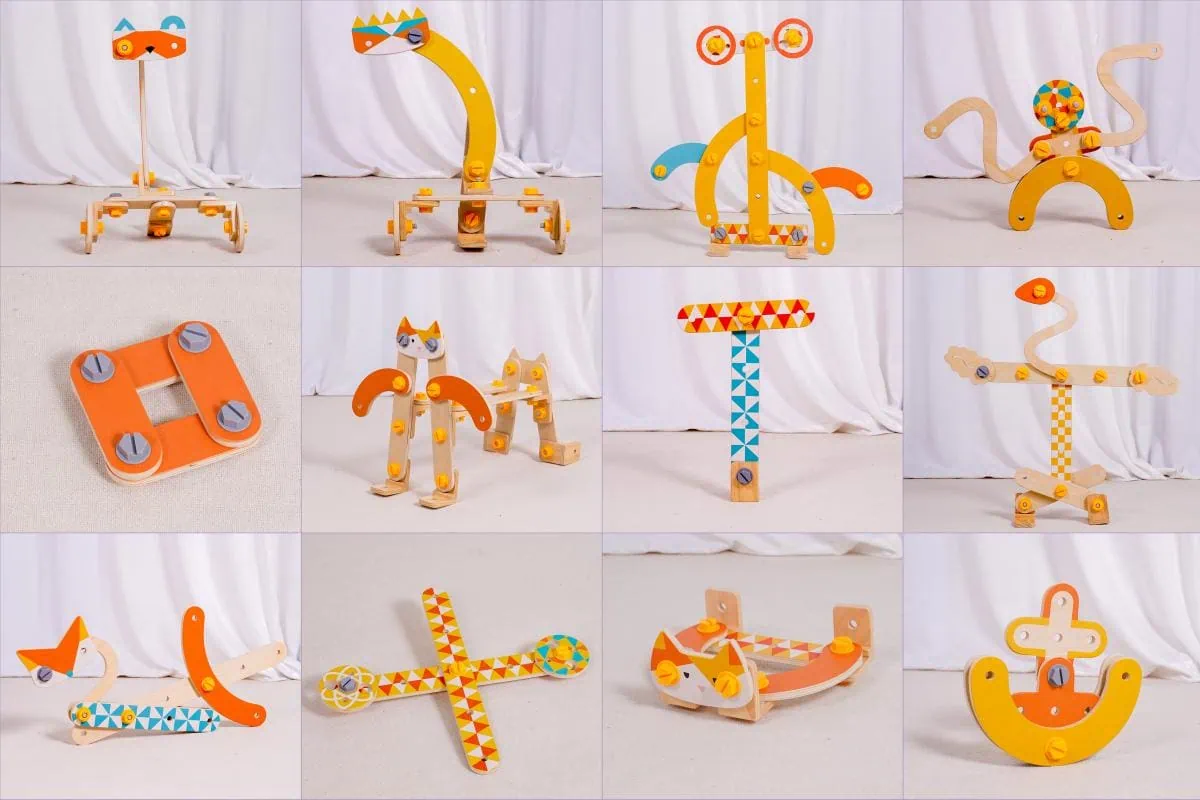
- Structural components: Check the available plank, panel and frame shapes, including their dimensions and connection points.
- Fasteners: Review the bolt, nut and connector design, required tools and suitability for the intended age range.
- Moving components: Confirm how wheels, axles, gears or pulleys connect and whether they are included in the selected configuration.
- Compatibility: Ask whether components from different set sizes or later expansion packs can be used together.
- Activity support: Determine whether the set includes activity suggestions, component guides or educator information.
- Storage: Consider how children and staff will identify, organise, move and count the components.
- Replacement parts: Ask whether frequently used connectors and individual components can be reordered.
A set with a very high component count may still be difficult to use if it lacks enough compatible connectors or practical storage. Request a complete component list before comparing quotations.
Classroom Applications for Mechanical Construction Sets
Mechanical construction sets can support both child-led play and planned learning experiences. Educators can begin with free exploration before introducing a question or design challenge.
Explore the Connections
Begin by showing children how the components connect and how to use any included fasteners correctly. Allow time to investigate the parts without requiring a specific finished model.
Build for a Purpose
Invite children to create something for a practical or imaginative purpose. They might design a cart for moving objects, a stand for displaying materials or a structure connected to a current classroom story.
Test One Feature
Educators can focus attention on one question: Does the structure remain stable? Do the wheels rotate freely? What happens when the axle position changes? Keeping the question focused helps children observe cause and effect.
Document and Revisit
Photographs, drawings and children’s explanations can document the design process. Returning to an earlier construction gives children an opportunity to remember their decisions and consider improvements.

The Educator’s Role in Construction Play
Adult involvement should support safe use and deeper thinking without taking control of every design decision. The appropriate level of guidance will vary according to the children’s experience and the complexity of the system.
- Introduce safe handling: Demonstrate how to carry, connect and return the components.
- Observe first: Give children time to investigate before offering a solution.
- Ask open questions: Use prompts such as “What are you trying to make?” or “What could you change?”
- Support participation: Provide different roles so children can contribute through planning, selecting parts, connecting or documenting.
- Encourage reflection: Ask children to explain what worked, what changed and what they might try next.
Educators should not encourage children to climb, sit, ride or place weight on a construction unless that use is specifically permitted by the manufacturer’s instructions for the selected product.
Safety and Maintenance Checks
Large construction systems contain multiple components and connection points, so supervision, routine inspection and clear storage procedures are important. Always follow the instructions supplied with the specific model.
- Intended users: Confirm the recommended age range, supervision requirements and any restrictions on use.
- Component condition: Check wooden surfaces, edges, holes and connection areas for cracking, roughness or other damage.
- Fastener condition: Inspect bolts, nuts, connectors and moving parts for wear, deformation or missing pieces.
- Activity area: Provide sufficient clear space for assembly and movement around the project.
- Construction stability: Help children identify unstable assemblies and dismantle constructions safely after use.
- Cleaning: Use cleaning methods appropriate for the confirmed materials and finishes.
- Storage: Return components to a dry, organised location and remove damaged pieces from use.
Indoor or outdoor suitability must be confirmed for the individual product. Wooden construction alone does not mean a set is designed for permanent outdoor exposure.
How Distributors Should Evaluate a Construction System
For a distributor or importer, the product must work as a complete commercial system. Beyond the classroom experience, consider how the range will be demonstrated, packed, replenished and supported after sale.

Review a Physical Sample
Where practical, assemble and use a sample before confirming a bulk order. Review the fit of the components, ease of connection, surface finish, instructions, packing method and storage arrangement.
Confirm the Exact Specification
Record the material, dimensions, component quantities, colours, hardware, packaging and included documents for the approved model. Product photographs should not replace a written specification.
Request Market-Relevant Documentation
Ask for test reports and supporting documents applicable to the selected product, intended age group and destination market. Do not assume that one report automatically covers every configuration, material or customised version.
Evaluate Packaging and Logistics
Large wooden systems may contain heavy or irregular components. Confirm carton quantities, package dimensions, gross weight, assembly requirements and loading information when estimating landed cost.
Plan for Replacement and Expansion
Lost fasteners or damaged components can reduce the usefulness of a complete set. Ask how replacement parts are identified and whether customers can expand an existing system without replacing the full collection.
OEM and Private-Label Construction Systems
Founded in 2008, Sing2sky develops wooden educational toys, preschool equipment and mechanical construction products for distributors, importers and OEM brands.
Available cooperation may include product selection, colour coordination, component configuration, branding, packaging and supporting promotional materials. The feasibility, minimum quantity, sample process and lead time should be confirmed for each project.
Functional changes require particular care. Adjusting the dimensions, materials, connector design, component weight or intended use may affect handling, packaging and applicable testing. Buyers should approve a final sample and specification before mass production.
Distributors building a broader product range can also coordinate mechanical construction sets with blocks, loose parts, classroom furniture and gross-motor equipment. This creates a clearer collection for different learning environments without presenting every product as serving the same purpose.
What to Include in Your Quotation Request
- Your company type and destination market.
- The selected model, configuration or reference images.
- The intended age range and use environment.
- Your estimated quantity and target delivery schedule.
- Required packaging, language and branding.
- Required testing or market-specific documentation.
- Whether replacement components or expansion packs are needed.
Frequently Asked Questions
What age group can use a wooden construction system?
The appropriate age range depends on the component dimensions, fasteners, product complexity and manufacturer’s assessment. Check the age marking and instructions for the specific model rather than applying one age recommendation to every system.
How many children can use one set?
This depends on the number and type of components, available space and activity format. Small groups often make it easier for children to access the parts and take an active role, but educators should adapt the arrangement to their setting.
Can children climb or ride their constructions?
Not unless the specific product has been designed, tested and instructed for that use. A construction that looks like a vehicle, seat or climbing frame should not automatically be treated as load-bearing equipment.
Can wooden construction systems be used outdoors?
Only when outdoor use is confirmed in the product information. For products intended primarily for indoor use, exposure to moisture, direct sunlight or temperature changes may affect the wood and hardware.
Can components be customised for a private-label range?
Colours, packaging, branding and selected configurations may be customisable. Any change to functional components should be reviewed carefully and may require a new sample or additional testing.
Conclusion
A well-designed wooden construction system can offer more than a collection of building parts. It can create opportunities for children to plan, communicate, test mechanical ideas and improve a design through practical experience.
For professional buyers, the strongest purchasing decision combines educational value with clear specifications, suitable documentation, practical storage and dependable replacement support. Comparing the complete system—not just its price or piece count—helps distributors select products that remain useful after the initial sale.
Explore the Mechanical Construction Sets and our wider educational product range, or contact us for configurations, OEM options and quotation details.







