

Preschool outdoor play equipment can extend learning beyond the classroom by creating opportunities for movement, construction, role play, sensory investigation and contact with natural materials.
For early learning groups, educational distributors and project buyers, selecting suitable preschool outdoor play equipment requires more than comparing appearance and price. The decision may involve age grading, site measurements, protective surfacing, accessibility, climate, installation, inspection and market-specific documentation.
This guide explains the main equipment categories and ten practical checks for planning a safer, more useful and maintainable outdoor learning environment.

What Is Preschool Outdoor Play Equipment?
Preschool outdoor play equipment may include fixed climbing structures, slides, playhouses, sand and water stations, planting equipment, balance elements, large construction materials and movable activity resources.
These products should not automatically be treated as one regulatory category. A fixed public-use climbing structure may be evaluated differently from portable wooden blocks, a garden planter, a ride-on toy or outdoor furniture.
Before requesting test reports or quotations, buyers should define:
- Who will use the product and the intended age range.
- Whether the product will be fixed, freestanding or portable.
- Whether children can climb, ride, enter or bear weight on it.
- Whether it will be used in a public, institutional or domestic setting.
- Whether it is intended for permanent outdoor exposure or supervised outdoor sessions.
Correct product classification helps determine which standards, tests, installation requirements and warnings may apply.
How Outdoor Equipment Supports Early Learning
Outdoor play creates different possibilities from a conventional indoor classroom. Children may have more space to move, transport materials, cooperate on larger projects and investigate weather, plants, water and changes in the natural environment.
Head Start describes early learning environments as including both indoor and outdoor opportunities for choice, play, exploration and experimentation. Equipment and materials should remain age-appropriate and connected to the program’s actual learning environment.
Depending on its design, preschool outdoor play equipment may create opportunities for:
- Movement: Walking, balancing, climbing, pushing, pulling and carrying.
- Problem-solving: Choosing routes, arranging components and testing ideas.
- Communication: Planning shared games and agreeing on roles.
- Sensory investigation: Exploring water, sand, texture, sound and natural materials.
- Imaginative play: Transforming playhouses, shops and open structures into new settings.
The equipment itself does not guarantee a particular developmental result. Educational value depends on product design, the environment, supervision and how children use the materials.
10 Smart Tips for Choosing Preschool Outdoor Play Equipment
1. Define the Product Category First
Determine whether the item is fixed playground equipment, portable play equipment, a toy, outdoor furniture or another product type. Do not assume that one report or standard covers every outdoor product.
2. Confirm the Intended Age Group
Review the manufacturer’s age designation, dimensions, intended activities and use restrictions. Mixed-age facilities may need separate zones or operating procedures to prevent younger children from accessing inappropriate equipment.
3. Conduct a Site Assessment
Measure the complete site rather than only the footprint of the product. Consider circulation, supervision, boundaries, drainage, shade, existing structures, underground services and any required use zones.
4. Review Protective Surfacing
Equipment involving fall exposure may require impact-attenuating surfacing appropriate to the equipment, fall height and applicable local requirements. Surfacing must also be installed and maintained correctly.
5. Plan for Accessibility
Review accessible routes, transfer opportunities, ground-level activities, reach ranges and the types of play available to children with different abilities. Accessibility should be planned across the full play experience, not added as a single separate component.
6. Match Materials to the Climate
Sun exposure, rain, humidity, temperature changes, salt air, insects and ground moisture can affect wood, metal, plastic, coatings and hardware differently. Request material and maintenance information relevant to the destination climate.
7. Examine Supervision and Sight Lines
Enclosed spaces, high panels and dense layouts may make supervision more difficult. Buyers should consider visibility, access points and how adults can respond when children need assistance.
8. Review Installation Requirements
Confirm foundations, anchors, tools, installer qualifications, assembly instructions and post-installation inspection. Large products should not be ordered before the site and installation responsibilities are clear.
9. Calculate Lifecycle Requirements
Compare purchase price together with freight, installation, surfacing, inspection, cleaning, treatment, replacement parts and expected maintenance. The lowest equipment price may not represent the lowest installed cost.
10. Approve Specifications and Samples
For customised or repeat orders, document the approved materials, dimensions, components, finishes, hardware, packaging and instructions. Functional changes may affect installation, use and applicable testing.
Types of Preschool Outdoor Play Equipment
Climbing and Gross-Motor Equipment
Climbing frames, balance components, ramps, tunnels and slides can provide different movement challenges. The required dimensions, barriers, hand supports, surfacing and use zones depend on the selected design and applicable requirements.
Explore the Infant & Toddler Equipment as one example of a coordinated early-years play configuration.
Outdoor Playhouses and Role-Play Structures
Playhouses, shops, stages and outdoor kitchens can support shared storytelling and role play. Review visibility, ventilation, openings, counters, doors, hardware and whether the structure requires anchoring.

Planting and Nature-Exploration Equipment
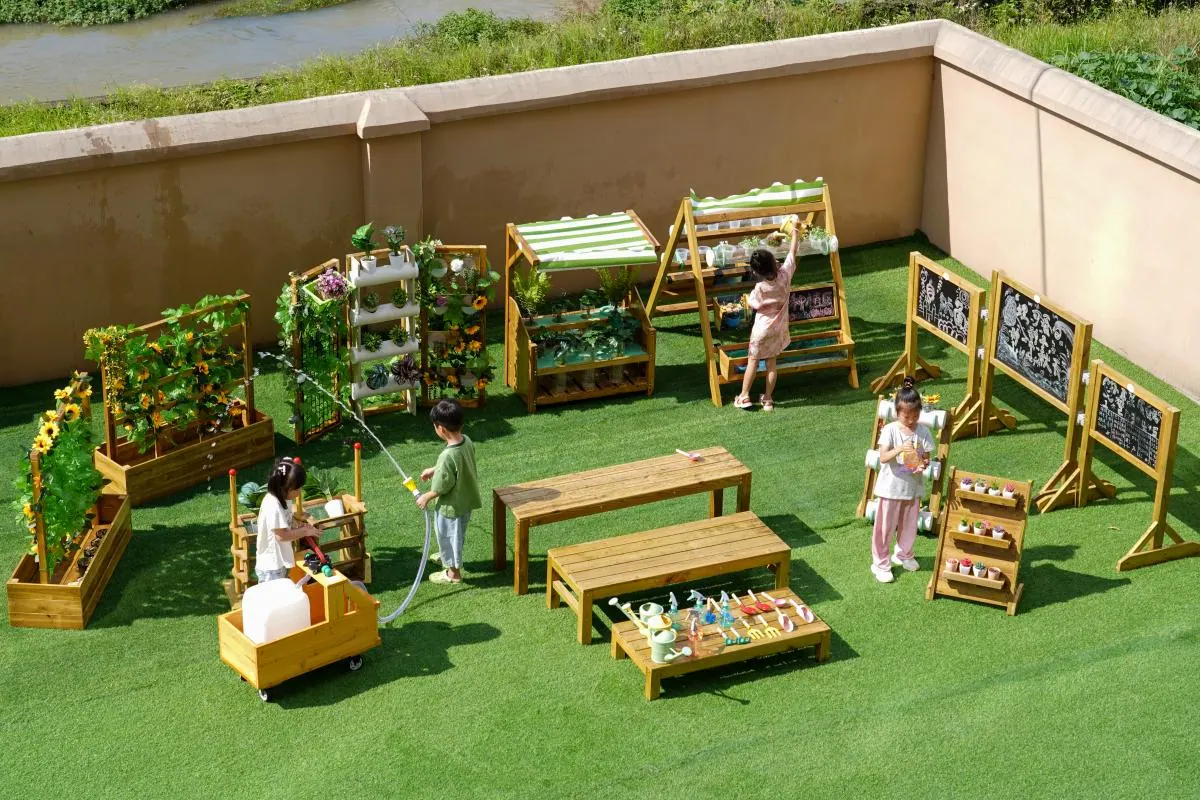
Raised beds, planting tables, observation stations and child-scaled garden equipment can connect outdoor play with seasonal change and living things. Consider drainage, water access, working height, soil contact and cleaning.
See our guide to a preschool garden theme for additional ideas.

Sand and Water Equipment
Sand tables, water channels, pumps, containers and mud kitchens can support transferring, filling, measuring and collaborative investigation. Check hygiene procedures, drainage, water management, covers, component storage and slip risks.
Portable Construction and Loose Parts
Outdoor blocks, planks, crates and connecting components allow children to modify the play environment. Buyers should confirm component weight, storage, weather exposure, supervision and whether children are permitted to stand, sit or climb on completed constructions.

Safety Standards and Project Compliance
The rules and standards applicable to preschool outdoor play equipment vary by country, site type, product category and intended users. Professional buyers should verify the requirements for the destination project rather than requesting a generic “playground certificate.”
In the United States, the CPSC Public Playground Safety Handbook provides guidance for purchasers, installers, designers and operators. The handbook explains that its recommendations are guidelines and should be considered together with applicable standards and state or local requirements.
The CPSC also provides separate business guidance for playground equipment. Buyers should determine whether standards such as ASTM F1487, ASTM F2373 or another product standard apply to the selected equipment and age group.
- Use zones: Confirm the clear space required around each component.
- Fall height and surfacing: Coordinate the equipment with an appropriate tested surface system.
- Entrapment and entanglement: Review openings, projections, ropes, fasteners and moving components.
- Structural integrity: Confirm loads, connections, anchors and foundations applicable to the design.
- Age separation: Prevent equipment intended for one age group from being presented misleadingly to another.
- Installation: Complete the required inspection before opening the equipment for use.
Accessibility and Inclusive Outdoor Play
An inclusive space should provide meaningful play choices rather than only physical entry into the area. Consider routes, surfaces, transfer points, working heights, sensory experiences, quiet spaces and opportunities for children to play together.
For applicable U.S. projects, the ADA play-area requirements address accessibility for play structures, water features, play tables and related spaces. Local regulations and project specifications should also be reviewed.
Accessibility features require ongoing maintenance. A route or surface that is initially compliant may become difficult to use if loose materials shift, drainage fails or storage blocks access.
Selecting Materials for Outdoor Conditions
No single material is automatically best for all preschool outdoor play equipment. Wood, metal, plastic, rope, rubber and mixed-material systems each have different performance and maintenance considerations.
Wooden Outdoor Equipment
Wood can provide a natural visual character and can be formed into many play and learning products. Buyers should confirm the wood species or board type, treatment, coating, moisture control, joints, hardware and suitability for ground contact or permanent exposure.
Wooden equipment is not automatically weather-resistant, environmentally preferable or maintenance-free. FSC or PEFC documentation, where applicable, supports particular sourcing claims but does not replace product safety assessment.

Metal, Plastic and Mixed Materials
Metal can provide structural strength but may require attention to corrosion, surface temperature and coatings. Plastic components vary widely in formulation, thickness and UV resistance. Ropes, fabrics and rubber parts also require material-specific inspection and replacement procedures.
Request exact material specifications instead of relying on broad descriptions such as “commercial grade,” “eco-friendly” or “all-weather.”
Installation and Project Handover
Correct installation is part of the safety of preschool outdoor play equipment. A well-manufactured product can still become unsuitable if foundations, anchors, clearances or surfacing are incorrect.
- Confirm the final site plan and equipment orientation.
- Review foundations, anchors, utilities and drainage.
- Use the supplied assembly and installation instructions.
- Record any approved site-specific changes.
- Inspect completed connections, clearances and surfacing.
- Provide operating, inspection and maintenance information to the facility.
- Do not open the area until required acceptance checks are complete.
Inspection and Maintenance Planning
Inspection frequency should reflect the product, usage level, materials, environment and applicable requirements. A fixed universal daily, monthly or annual schedule may not suit every site.
- Routine visual checks: Look for damage, debris, vandalism, loose parts and obvious hazards.
- Operational inspections: Examine wear, connections, movement, stability and surfacing condition.
- Detailed inspections: Review structural condition, corrosion, decay, foundations and components that are not visible during routine checks.
- Record keeping: Document findings, repairs, replacement parts and reopening decisions.
Damaged or uncertain equipment should be restricted from use until it has been assessed and made suitable. Repairs, refinishing and replacement hardware should follow the manufacturer’s instructions and approved specification.
Evaluating an Outdoor Equipment Supplier
A supplier of preschool outdoor play equipment should be able to support the complete purchasing process, not only provide attractive product images.
- Specifications: Materials, dimensions, components, capacity, finishes and intended use.
- Drawings: Product dimensions, assembly details and site information where applicable.
- Documentation: Test reports and supporting records relevant to the selected model and market.
- Installation information: Foundations, anchoring, tools, instructions and installer responsibilities.
- Packaging and logistics: Carton or crate dimensions, weights, loading method and delivery access.
- Replacement support: Hardware, wear components, individual parts and identification methods.
- Change control: Written approval before materials or functional details are changed.
Founded in 2008, Sing2sky develops wooden educational toys, early-years equipment, sensory and gross-motor resources, planting products and outdoor play systems for distributors, importers, preschool groups and OEM brands.
Available cooperation may include product selection, coordinated outdoor collections, custom colours, branding, packaging, sampling and promotional materials. Feasibility, minimum order quantity, lead time and applicable testing should be confirmed for each project.
Frequently Asked Questions
What is the best preschool outdoor play equipment?
There is no universal best product. The appropriate choice depends on user age, site conditions, supervision, learning goals, climate, accessibility, installation and applicable requirements.
Does every outdoor product need playground surfacing?
No. Surfacing requirements depend on product classification, intended activities, fall exposure and local rules. Fixed climbing equipment and a ground-level planting table do not necessarily require the same site treatment.
Is wooden outdoor equipment weather-resistant?
Only when the selected materials, treatment, construction and maintenance are suitable for the stated exposure conditions. Buyers should not assume all wooden products can remain outdoors permanently.
Can an indoor product be moved outdoors?
Only if the manufacturer confirms the intended outdoor conditions. Moisture, sunlight, temperature changes, wind and ground conditions may affect materials, stability and safe use.
What information is needed for an outdoor equipment quotation?
Provide the destination market, user age, site dimensions, surface type, climate, selected products, estimated quantity, installation expectations, branding requirements and delivery location.
Conclusion
Selecting preschool outdoor play equipment is both a product decision and a site-planning decision. Age suitability, classification, surfacing, accessibility, climate, installation and maintenance all affect whether the final environment works as intended.
Professional buyers should verify the complete specification and documentation rather than relying on general claims such as “safe,” “commercial grade” or “all-weather.” A coordinated review before ordering can reduce costly changes during installation.
Explore the complete Sing2sky educational and outdoor product range, browse our product catalogue, or contact us to discuss wholesale, OEM and outdoor learning projects.







