

Teaching aids for preschool make learning ideas easier to explore through play. A set of blocks can become a bridge, picture cards can start a conversation, and counting materials can help children compare quantities they can see and handle.
The value of these tools comes from how children use them. Effective preschool learning materials invite questions, offer manageable challenges, and give educators opportunities to observe and extend children’s thinking.
This guide explores eight practical ways to select and use teaching aids for preschool, with classroom examples and useful considerations for educational distributors, education groups, and project suppliers.
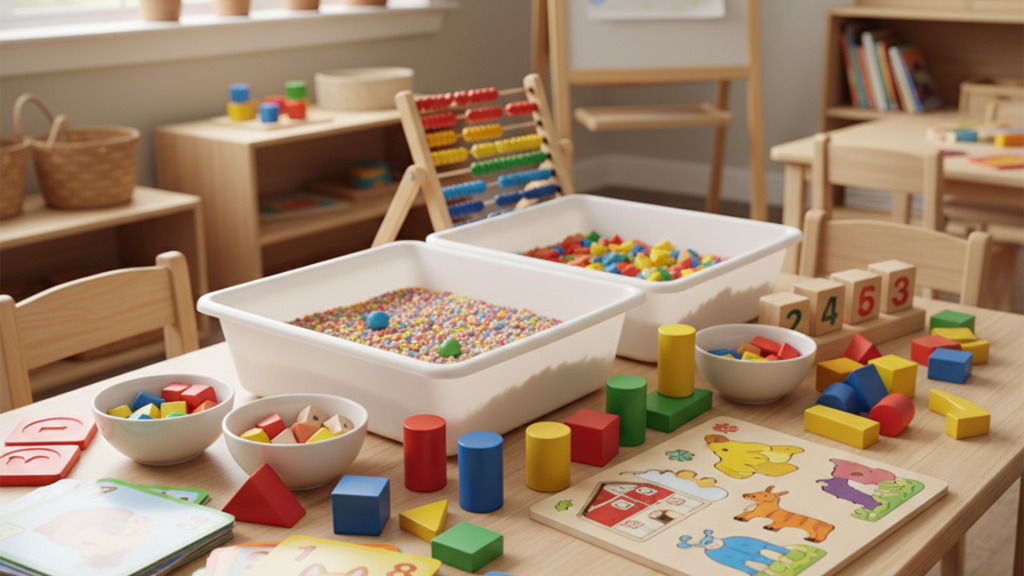
What Are Teaching Aids for Preschool?
Teaching aids for preschool are materials that help educators introduce, demonstrate, or extend learning experiences. They include picture books, puppets, blocks, puzzles, counting resources, musical instruments, visual schedules, and selected digital media.
Some have a defined purpose, such as matching a numeral to a quantity. Others are open-ended: children decide what to build, how to organize the pieces, or which story to tell.
The NAEYC framework for developmentally appropriate practice emphasizes a play-based approach that considers children’s development, individual characteristics, and context. Applied to classroom resources, this means choosing materials around the children and the activity rather than expecting one tool to suit everyone.
1. Use Picture Resources to Start Meaningful Conversations
Picture books, photographs, story cards, and puppets can support conversation without turning every activity into a recall test. Choose clear images connected to children’s experiences, interests, and home languages.
Try a story basket: Pair a picture book with a few suitable figures or props. Invite children to retell part of the story, change the ending, or create a new adventure.
Useful prompts include “What might happen next?” and “How could this character solve the problem?” Allow children to respond through words, gestures, drawings, or arranging the props.
Visual teaching aids for preschool can also make routines easier to follow. Picture labels and simple activity sequences help communicate where materials belong and what happens next.
2. Make Early Mathematics Concrete
Math teaching aids for preschool give children objects to count, group, compare, and arrange. Begin with familiar quantities and simple relationships before introducing more complex tasks.
Counting and Matching
Provide appropriately sized counting pieces and a small collection of picture or numeral cards. Children can place one object beside each picture, then compare groups to discover which has more, fewer, or the same number.
Sorting and Patterns
Invite children to sort blocks by shape, color, or size. Ask them to explain their rule, then explore whether the same collection can be sorted another way. Introduce a simple repeating pattern and let children continue or change it.
Measurement Through Play
Use equal-sized blocks to compare the lengths of two toy roads. Place the blocks end to end without gaps and discuss why using the same unit makes comparison easier.
NAEYC’s resource on preschool mathematics offers examples of counting, sorting, and comparing in everyday experiences. For related classroom ideas, explore our guide to counting toys for preschool.
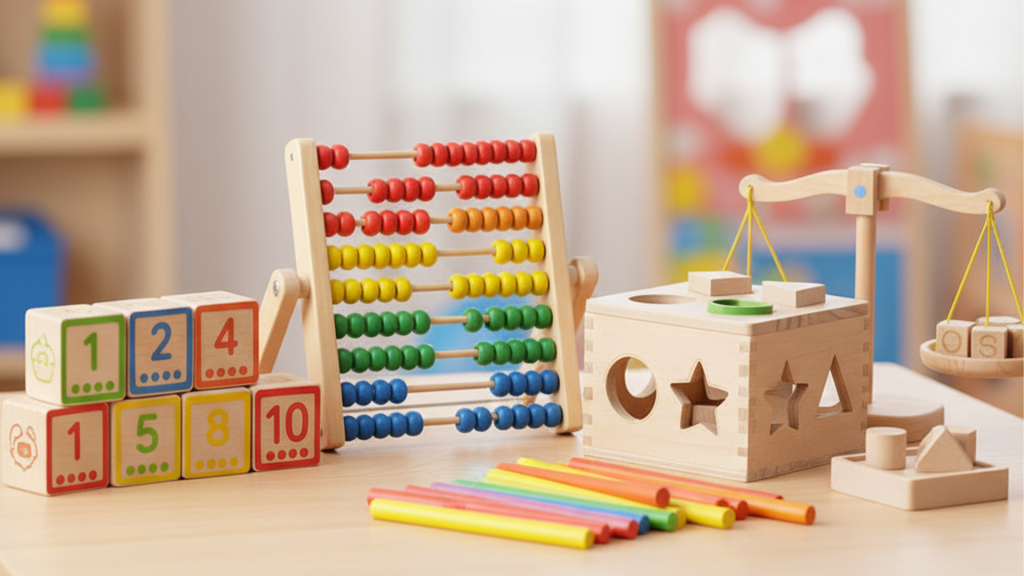
3. Turn Construction Materials into Problem-Solving Opportunities
Blocks and construction resources let children test ideas and change their plans. A tower that falls or a bridge that is too narrow creates an immediate reason to investigate.
Try a bridge invitation: Provide blocks and a suitable toy vehicle. Invite children to build a bridge the vehicle can travel beneath. Let them decide the design, test the opening, and make adjustments.
Educators can ask “What changed when you moved that block?” or “How could you make more space?” Give children time to respond through building rather than supplying the solution immediately.
4. Add Purposeful Sensory and Fine Motor Activities
Puzzles, texture boards, stacking pieces, and suitable lacing resources offer opportunities to practice handling objects and coordinating movements. Choose a level of difficulty that allows exploration without requiring constant adult correction.
Try a texture comparison: Offer a small selection of suitable textured materials. Children can group similar surfaces, describe differences, or match a material to a photograph.
Try a transfer task: Provide easy-grip tools and appropriately sized objects to move between trays. Adjust the tools and containers to the children’s handling abilities.
Offer alternatives for children who prefer different textures or need adapted grips. Sensory activities should allow choice; touching every material is not a requirement for participation.
5. Use Dramatic Play Props for Language and Cooperation
Pretend-play resources become teaching aids for preschool when they support meaningful exchanges. Menus, shopping lists, dolls, play food, and community figures give children reasons to describe ideas and coordinate roles.
Try a classroom café: Set out suitable dishes, play food, a picture menu, and paper for orders. Children can decide who prepares food, welcomes customers, or records requests.
Model useful language when needed: “May I order two apples?” or “What could we do if both customers want this plate?” Keep the storyline flexible so children can contribute their own experiences.
Include familiar foods, different family roles, and signs in relevant home languages. Avoid assigning roles by gender or expecting every child to speak before joining the activity.
6. Create Simple Handmade Teaching Aids
Handmade teaching aids for preschool can adapt an activity to a current topic, local setting, or language. They are especially useful for picture resources and classroom labels.
- Matching cards: Use photographs of familiar classroom objects.
- Story sequences: Arrange pictures showing a familiar routine and invite children to discuss the order.
- Sorting mats: Draw simple categories for children to organize suitable objects.
- Role-play signs: Create menus, appointment cards, or open-and-closed signs together.
- Storage labels: Pair an image with a word to identify where a resource belongs.
Check handmade resources for sharp edges, loose components, and wear. Reused packaging needs inspection and cleaning before classroom use. Prefer simple paper-based resources over improvised products containing small fillers, magnets, batteries, or unknown coatings.
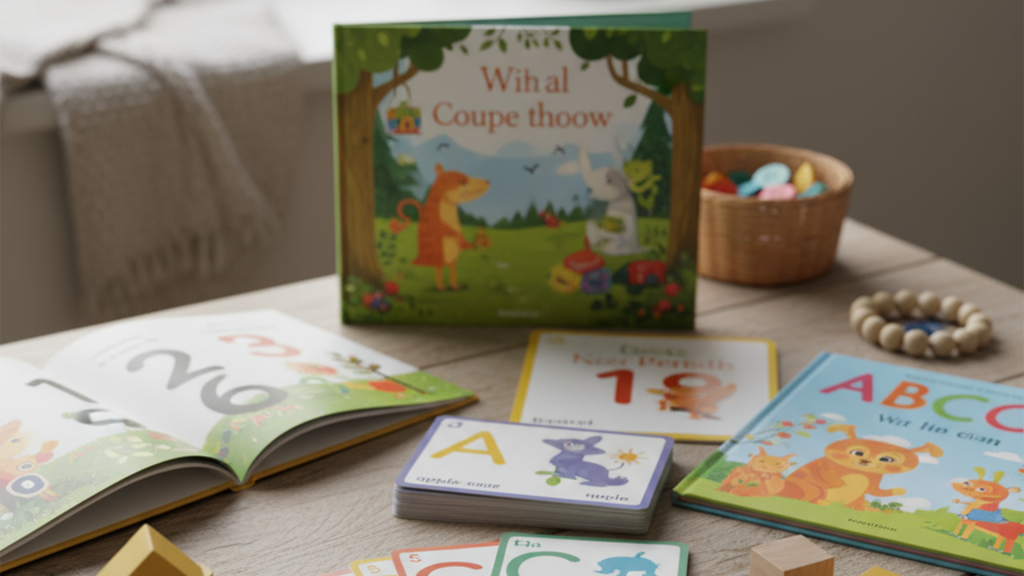
7. Choose Digital Tools for a Clear Learning Purpose
Digital teaching aids for preschool can support selected activities when they serve a clear purpose. A photograph can help children revisit yesterday’s construction, while an audio recording can capture a story in a child’s home language.
The NAEYC resources on technology and media emphasize intentional, developmentally appropriate use. A practical classroom approach is to connect digital content to conversation, making, or exploration.
Try a construction review: Display a photograph of a previous block structure. Ask children what they notice and what they would change, then return to the physical materials to test their ideas.
Before adding an app or device, assess its content, accessibility, advertising, data collection, and staff support requirements. Include charging, storage, updates, and replacement costs in the project budget.
8. Organize, Observe, and Adapt the Collection
Teaching aids for preschool work best when they are easy to access and presented in manageable collections. A crowded shelf can make it difficult to see which pieces belong together or how an activity begins.
- Group related resources: Keep a complete activity together in a suitable tray or container.
- Demonstrate essential handling: Show how to carry, use, and return materials.
- Allow exploration: Leave room for children’s ideas within appropriate use boundaries.
- Observe the activity: Notice questions, repeated strategies, difficulties, and collaboration.
- Make targeted changes: Adjust complexity, add a useful prop, or offer a different presentation.
Rotate resources in response to children’s interests and the curriculum. Keep frequently used materials available when they continue to support purposeful play.
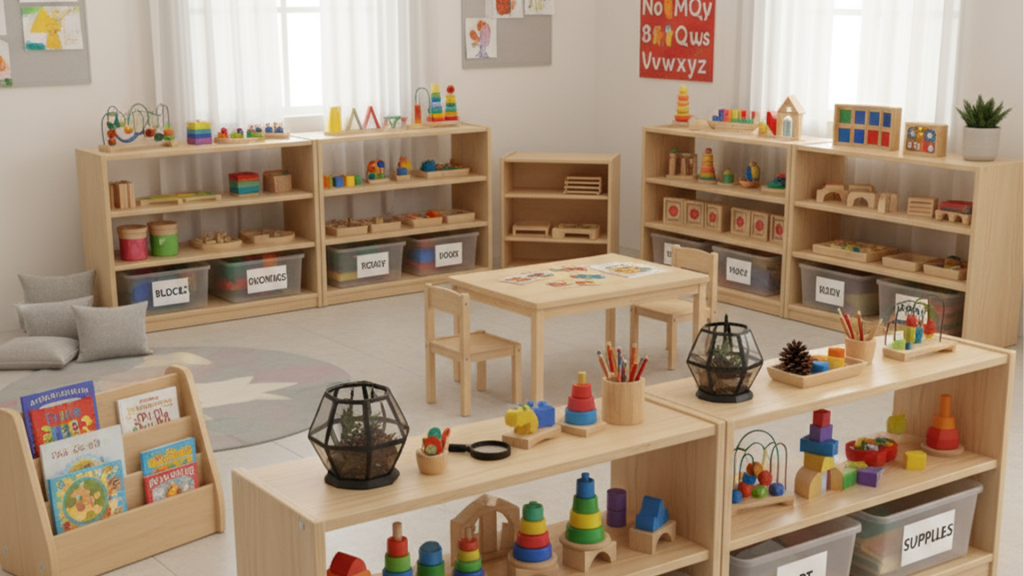
How to Select Quality Teaching Aids for Preschool
Classroom suitability depends on the complete product, including its design, components, finish, and instructions. Wooden teaching aids can offer useful weight and texture, but material alone does not establish safety, educational value, or environmental performance.
For product selection, review:
- Age and handling suitability: Check age grading, piece size, weight, and grip.
- Activity value: Identify what children can explore and how educators can extend it.
- Accessibility: Consider visual clarity, contrast, communication, and handling adaptations.
- Construction: Examine edges, joints, moving parts, and detachable components.
- Care: Confirm cleaning instructions, storage needs, and replacement options.
- Documentation: Request applicable reports and compliance documents for the specific model and destination market.
For products classified as toys in the United States, the CPSC’s toy safety guidance explains relevant testing and certification requirements. Different product categories and destination markets need their own review.
Frequently Asked Questions
Which teaching aids should a preschool introduce first?
Begin with versatile resources such as picture books, blocks, simple puzzles, counting and sorting materials, and pretend-play props. Choose complexity according to the children and the intended activity.
How are teaching aids different from educational toys?
The terms overlap. An educational toy can become a teaching aid when an educator uses it to introduce or extend an idea. Teaching aids also include resources such as visual schedules, photographs, and story cards.
Are handmade teaching aids suitable for classroom use?
Simple handmade picture cards, labels, and sorting mats can be useful when they are appropriate for the users and checked regularly. Their suitability depends on the materials, construction, and planned activity.
How can educators tell whether a teaching aid is useful?
Observe what children do with it: the questions they ask, strategies they try, explanations they offer, and support they need. Use these observations to adapt the activity rather than relying only on completion or time spent.
Explore Preschool Learning Materials with Sing2sky
Thoughtfully selected teaching aids for preschool give children materials to investigate and educators opportunities to respond. Start with useful core resources, present them clearly, and develop the collection through observation.
Sing2sky manufactures wooden educational products for hands-on learning environments. Educational distributors, importers, education groups, and project suppliers can explore our product range and catalog to prepare a coordinated collection.
For wholesale or OEM/ODM discussions, contact Sing2sky with your target market, intended age range, learning categories, and estimated quantities.







